Celtic Knot Meanings & Symbols Explained

Celtic knots are decorative patterns made from interwoven lines that cross over and under one another, often forming continuous loops with no visible beginning or end. They’re among the most recognisable designs associated with Irish and Celtic art.
Although interlaced patterns existed in several ancient cultures, Celtic knotwork became particularly prominent in early medieval Ireland and Britain, appearing in manuscripts such as the Book of Kells, stone carvings and decorative metalwork.
Today, Celtic knots are commonly associated with eternity, love, strength and protection. However, it’s worth knowing that many of the meanings attached to individual designs are modern interpretations rather than beliefs documented in early Celtic or medieval Irish sources.
In this guide, I’ll explain the different Celtic knot meanings, their designs and origins, and how to distinguish historical designs from more recent creations.
Celtic Knot meanings explained
| Design | Commonly associated meaning | Historical context |
|---|---|---|
| Trinity Knot (Triquetra) | Trinity, unity, eternity | Historic motif, with later Christian interpretations |
| Dara Knot | Strength, resilience, wisdom | Modern Celtic-inspired design |
| Celtic Shield Knot | Protection, security | Modern name and interpretation of interlace designs |
| Solomon's Knot | Connection, continuity | Historic motif found in multiple cultures |
| Sailor's Knot | Love, loyalty, separation | Modern Celtic-themed association |
| Serch Bythol | Eternal love, partnership | Modern symbolic interpretation |
| Motherhood Knot | Mother-child bond, family | Modern design |
| Celtic Love Knot | Love, commitment | Modern design |
| Spiral and Triskele | Movement, cycles, renewal | Ancient Celtic motifs, not strictly knots |
There is no single Celtic Knot meaning. While their continuous, interwoven lines are often interpreted as symbols of eternity and interconnectedness, individual designs have also become associated with love, strength, protection and family.
The table above outlines these meanings and, importantly, distinguishes historical motifs from more recent Celtic Symbols and designs.
Types of Celtic Knots
There are numerous types of Celtic knots, from historical designs found in early medieval manuscripts and stone carvings to more recent symbols inspired by traditional knotwork. Some, like the Trinity Knot, have a documented history spanning centuries.
Others, such as the Dara Knot and Motherhood Knot, are modern designs with meanings that have developed over time. Below, I’ll take you through the most recognisable Celtic knot meanings, explain what each symbolises and highlight where their history is often misunderstood.
1. The Trinity Knot (Triquetra)

The Trinity Knot, also known as the Triquetra, is one of the most recognisable Celtic knot designs. It features three interlocking, pointed loops that form a distinctive three-cornered shape, sometimes surrounded by a circle.
The name comes from the Latin triquetrus, meaning ‘three-cornered’. The design has a long history beyond Ireland, although it is particularly associated with Celtic art and Christian symbolism today.
Origins and history
Unlike many modern Celtic-inspired symbols, the Triquetra has a documented history. Versions of the three-cornered motif appear in historical European art, while interlaced forms became part of early medieval decorative traditions. The design was later adopted in Christian symbolism, where its three interconnected sections have been used to represent the Holy Trinity.
Trinity Knot meaning
The Trinity Knot is most commonly associated with unity, eternity and the number three. In Christianity, its three interconnected sections represent the Father, Son and Holy Spirit. Other popular interpretations connect the design to life, death and rebirth, or land, sea and sky. However, there is little historical evidence that these particular meanings were attached to the symbol by the ancient Celts.
Today, the Trinity Knot is widely used in jewellery, tattoos and artwork, particularly as a symbol of faith, unity or Irish heritage.
2. The Dara Knot

The Dara Knot is a notable Celtic symbol for strength, resilience and wisdom. Its interwoven lines are commonly interpreted as representing the roots of an oak tree, which anchor it firmly in the ground.
Unlike the Trinity Knot, there is no single recognised Dara Knot design. Some versions are circular, while others have square or diamond-shaped patterns.
Origins and history
The name Dara Knot is commonly linked to the Irish word doire, meaning ‘oak wood’ or ‘oak grove’. Although the oak has a long history in Irish culture, the Dara Knot itself is a different matter. There is no established historical record of a specific knot bearing this name in ancient Celtic art.
The interlaced patterns that inspire modern Dara Knot designs are much older. They can be seen in early medieval Irish manuscripts, stone carvings and metalwork.
Dara Knot meaning
The Dara Knot’s strongest association is with strength and resilience. The idea comes from the oak’s roots, which provide the support needed for the tree to withstand strong winds and difficult conditions.
The Dara Knot is also associated with wisdom, family and heritage, with its roots representing the connections that keep people grounded. These are modern interpretations rather than meanings documented in ancient Celtic traditions.
3. The Triskelion (Triple Spiral)

The Triskelion, also known as the Triskele or Triple Spiral, is one of the oldest and most recognisable spiral motifs associated with Ireland.
It features three spirals radiating from a central point, creating a design that appears to be in constant motion. Although it isn’t technically a Celtic knot, it’s often included in guides to Celtic knotwork because of its long association with Irish art and symbolism.
Origins and history
One of Ireland’s most famous examples of the triple spiral can be found at Newgrange in County Meath, a Neolithic passage tomb built around 3200 BC. The design appears on a carved stone inside the tomb, making it thousands of years older than the early medieval knotwork commonly associated with Celtic art.
It’s important to distinguish the ancient triple spiral motif from the broader Triskelion family of designs, which also includes three-legged and other three-part patterns found in different cultures. Although the triple spiral was used in prehistoric Ireland, its original meaning remains unknown.
Triskelion meaning
Today, the Triskelion is commonly associated with movement, progress and the cycles of life. Its three spirals are often interpreted as representing life, death and rebirth; past, present and future; or land, sea and sky.
The flowing design also lends itself to interpretations involving personal growth, change and the idea of moving forward.
However, these are largely modern symbolic associations. There is no reliable evidence establishing that the people who carved the triple spiral at Newgrange intended these particular meanings.
4. The Celtic Tree of Life

The Celtic Tree of Life is one of the most recognisable knot symbols associated with Celtic culture. Although it isn’t technically a knot, many modern designs incorporate the interwoven patterns found in traditional Celtic knotwork.
It typically features a tree with spreading branches and an extensive root system, often enclosed within a circle. The roots and branches sometimes mirror one another, creating a design that emphasises the connection between the earth and the world above.
Origins and history
Trees held an important place in early Irish traditions, with the oak particularly associated with strength, longevity and importance. Celtic mythology describe Celtic Gods emerging from its saplings and mankind forming from its bark, reinforcing the tree’s sacred role in creation.
Their significance is reflected in Irish place names and early literature, where certain trees were regarded as important landmarks and could hold special significance within communities.
However, while tree symbolism has deep historical roots in Ireland, the familiar circular Celtic Tree of Life design seen today isn’t established as a distinct symbol used by the ancient Celts. Instead, many contemporary versions combine older ideas about trees with decorative patterns inspired by Celtic art.
Celtic Tree of Life meaning
The Celtic Tree of Life is commonly associated with balance, interconnectedness and the cycle of life. Its roots represent stability, ancestry and a connection to the earth, while its branches symbolise growth, renewal and the passing of knowledge between generations.
Together, the roots and branches can represent the relationship between past and present, as well as the connection between people and the natural world. Today, the symbol is particularly popular in jewellery, tattoos and artwork, especially among those looking for a design representing family, heritage or belonging.
5. The Celtic Cross

The Celtic Cross is one of Ireland’s most recognisable historical symbols. Although it isn’t technically a Celtic knot, many examples feature intricate interwoven patterns, particularly on the stone high crosses found throughout Ireland.
Its most distinctive feature is the ring surrounding the intersection of the cross’s arms, setting it apart from a traditional Christian cross.
Origins and history
The Celtic Cross has a long history in Ireland, with some of the finest surviving examples dating to the 9th and 10th centuries. These early medieval high crosses were often decorated with biblical scenes, geometric patterns and intricate knotwork.
Well-known examples include the Cross of Muiredach at Monasterboice in County Louth and the high crosses at Clonmacnoise in County Offaly. You’ll often hear claims that St Patrick introduced the ringed cross by combining a Christian cross with an ancient sun symbol.
However, there’s no reliable historical evidence establishing this as its origin. What we do know is that ringed crosses became an important feature of early medieval Christian art in Ireland and Britain.
Symbolism and meaning
The Celtic Cross is primarily a Christian symbol, representing faith and the crucifixion of Jesus Christ. The ring surrounding its centre has attracted various interpretations, including eternity and the connection between heaven and earth.
However, the precise meaning intended by its early makers isn’t definitively established. Where Celtic knotwork appears on the cross, its continuous, interwoven lines are also commonly interpreted as symbols of eternity and interconnectedness.
Today, the Celtic Cross remains closely associated with Irish heritage and Christianity. You’ll find it in churchyards, on memorials and in jewellery, where it continues to represent faith, remembrance and cultural identity.
6. Solomon’s Knot

Solomon’s Knot is a decorative design made from two interlocking loops, creating a distinctive pattern with four rounded sections. Unlike many of the Celtic-inspired symbols discussed above, Solomon’s Knot has a documented history stretching back to the ancient world.
It isn’t exclusively Celtic, but examples of the design can be found in decorative art across several cultures.
Origins and history
Solomon’s Knot appears in Roman mosaics, where its interlocking loops were used to create decorative patterns on floors and other surfaces. The motif also appears in later European art, including medieval decorative traditions.
Its widespread use makes it difficult to associate the design with one particular culture or establish a single original meaning. Although Solomon’s Knot is sometimes included in collections of Celtic knots, it wasn’t invented by the Celts and shouldn’t be presented as a uniquely Irish symbol.
This Celtic knot meaning
Solomon’s Knot is commonly associated with unity, connection and continuity. Its two interlocking loops are often interpreted as representing a lasting connection between two people.
The continuous nature of the design also lends itself to modern interpretations involving eternity and lasting relationships. However, these meanings shouldn’t automatically be attributed to the ancient cultures that used the motif. Today, Solomon’s Knot appears in jewellery, tattoos and decorative artwork, particularly among those looking for a symbol of connection or unity.
7. Serch Bythol
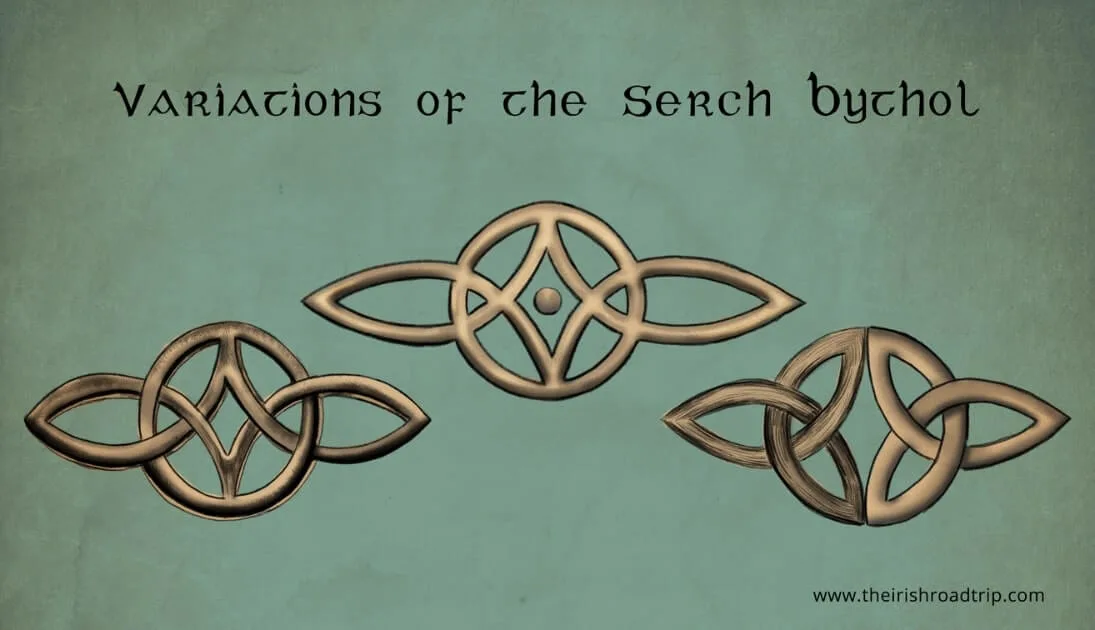
The Serch Bythol is a Celtic-inspired design associated with everlasting love and the bond between two people. At first glance, it can resemble an owl in flight.
Look closer, however, and you’ll see two Trinity Knot-style patterns positioned side by side, creating a larger interwoven design.
Origins and history
The name Serch Bythol is commonly interpreted as ‘everlasting love’, drawing on Welsh words associated with love and eternity.
Although the design incorporates elements inspired by traditional Celtic knotwork, there is no established historical evidence that Serch Bythol existed as a distinct, named symbol among the ancient Celts.
Its association with romantic love is best understood as a modern interpretation rather than a meaning documented in early Celtic traditions.
Serch Bythol meaning
The two connected Trinity Knot-style patterns represent two people coming together, while their interwoven lines symbolise lasting love and commitment. This makes it a popular choice among those looking for Celtic love symbols, particularly designs associated with marriage and long-term relationships.
8. The Motherhood Knot

The Celtic Motherhood Knot is a modern Celtic-inspired design associated with the bond between a mother and her children.
It typically features two interwoven heart-shaped loops, often arranged to resemble a mother embracing her child. Some versions also include small dots or additional elements representing individual children.
Origins and history
Although the Motherhood Knot draws inspiration from traditional Celtic interlace patterns, there is no established historical evidence that it existed as a distinct symbol in ancient Celtic or early medieval Irish art.
However, the familiar heart-shaped design and its association with motherhood are modern developments rather than meanings documented in historical Celtic traditions.
Motherhood knot meaning
The Motherhood Knot represents the enduring connection between a mother and her children.
Its intertwined lines are commonly interpreted as symbolising unconditional love, while the continuous pattern represents a bond that remains strong throughout life.
In designs featuring dots, each dot is often used to represent a child, allowing the symbol to be personalised for individual families.
Today, the Motherhood Knot is particularly popular in jewellery, tattoos and personalised gifts, especially among mothers looking for a symbol of their relationship with their children.
9. The Celtic Love Knot

The Celtic Love Knot is a Celtic-inspired design associated with romantic love, commitment and the connection between two people.
It typically features two interwoven heart shapes, although designs vary considerably. Some incorporate traditional Celtic interlace patterns, while others use simpler overlapping lines to create a continuous, heart-shaped motif.
Origins and history
The interwoven patterns found in Celtic Love Knot designs take inspiration from the knotwork used in early medieval Irish manuscripts, stone carvings and metalwork.
However, there’s no established historical evidence that a specific design known as the Celtic Love Knot was used by the ancient Celts to represent romantic relationships.
Claims that these knots were exchanged by ancient Celtic couples as tokens of affection or marriage shouldn’t be treated as established historical fact.
Celtic love knot meaning
The Celtic Love Knot is commonly associated with everlasting love, loyalty and commitment.
Its intertwined lines represent the connection between two people, while the continuous pattern can symbolise a relationship that endures through life’s challenges.
The heart-shaped design reinforces its romantic meaning, making it particularly popular among couples.
10. The Sailor’s Knot

The Sailor’s Knot is a Celtic-inspired design commonly associated with love, loyalty and the strength of a lasting relationship.
It typically features two interwoven ropes or loops, creating a pattern that represents the connection between two people. Unlike the Trinity Knot, there is no single universally recognised design known as the Celtic Sailor’s Knot.
Origins and history
Knots have played an important practical role in seafaring for centuries, with sailors relying on them to secure ropes, sails and equipment.
The decorative Sailor’s Knot seen in Celtic-inspired jewellery today is different from the practical knots used at sea.
You’ll often come across stories claiming that ancient Celtic sailors created decorative knots while at sea and gave them to their loved ones when they returned home.
Although it’s a romantic story, there is no established historical evidence that this was a specific Celtic tradition or that a distinct knot bearing this name existed in ancient Celtic art.
The decorative designs sold as Celtic Sailor’s Knots today are better understood as modern interpretations inspired by traditional ropework and interlaced patterns.
Sailor’s Knot meaning
The Sailor’s Knot is commonly associated with enduring love, loyalty and commitment. Its interwoven lines are often interpreted as representing two lives joined together, while the strength of the knot symbolises a relationship capable of withstanding difficult times. It’s also used to represent friendship and trust, making it a popular design for jewellery and tattoos.
The history of Celtic Knotwork and Irish knots
Although Celtic knots are closely associated with Ireland today, the tradition of decorating objects with interwoven lines didn’t begin with the Celts.
Interlaced patterns appeared in several ancient cultures, including Roman art, long before the elaborate knotwork found in early medieval Irish manuscripts.
What makes Celtic knotwork distinctive isn’t necessarily the invention of these patterns, but the extraordinary detail and creativity with which they were developed in Ireland and Britain.
The origins of Celtic knotwork
Early Celtic art was particularly known for its flowing curves, spirals and geometric designs. These decorative traditions existed long before the intricate interlace patterns that we now associate with Celtic knots became widespread.
Interwoven patterns were also used in Roman and other European artistic traditions, while Germanic and Anglo-Saxon art developed elaborate forms of interlace.
Over time, these different artistic influences contributed to the development of the distinctive knotwork found in early medieval Ireland and Britain.
Rather than having a single point of origin, Celtic knotwork is best understood as part of a wider artistic tradition that developed and changed over centuries.
Celtic knots in early medieval Ireland
Celtic knotwork became particularly prominent in Ireland during the early medieval period, especially from the 7th century onwards.
Monks and craftspeople used intricate interlaced patterns to decorate religious manuscripts, stone crosses and metalwork.
Similar decorative techniques can be seen on Ireland’s early medieval high crosses, including those at Monasterboice and Clonmacnoise.
These surviving works demonstrate the importance of knotwork as an artistic tradition, although they don’t establish the specific symbolic meanings commonly assigned to individual knots today.
Celtic knotwork in modern times
Today, Celtic knots remain among the most recognisable designs associated with Irish culture.
They’re widely used in jewellery, tattoos, artwork and memorials, often to represent love, eternity, strength or a connection to Irish heritage.
Some modern designs, including the Dara Knot and Motherhood Knot, draw inspiration from historical interlace patterns while incorporating meanings that developed much more recently.
FAQs about Celtic knot meanings
Is it OK to wear a Celtic knot?
Yes, you don’t need to be Irish or have Celtic ancestry to wear a Celtic knot. These designs are widely used in jewellery and clothing by people from all backgrounds. Some knots have religious associations, particularly the Trinity Knot, which is often used to represent the Christian Holy Trinity. Others are worn simply because someone appreciates the design or its modern meaning.
Are Celtic knots pagan or Christian?
Celtic knotwork is closely associated with early medieval Christian art, particularly illuminated manuscripts and stone crosses. However, interlaced decorative patterns also existed in other artistic traditions. Today, Celtic knots are used in both religious and non-religious contexts, and their meaning often depends on the particular design and the person using it.
What do Celtic knots symbolise?
Celtic knots are commonly associated with eternity, interconnectedness, love, strength and protection. Their continuous, interwoven lines are often interpreted as representing something without a beginning or end. However, there is no single meaning shared by every Celtic knot, and many of the interpretations popular today are modern.
Are Celtic knots Irish or Scottish?
Celtic knotwork is associated with both Ireland and Scotland, as well as other parts of Britain. Intricate interlace became particularly prominent in early medieval art, including religious manuscripts, stone carvings and metalwork. The artistic traditions developed across different regions and influenced one another, so Celtic knotwork cannot be attributed exclusively to either country.

Keith O’Hara has lived in Ireland for 37 years and has spent much of the last 13 creating what is now The Irish Road Trip guide. Over the years, the website has published thousands of meticulously researched Ireland travel guides, welcoming 40 million+ visitors along the way. Recently, the Irish Road Trip team published the world’s largest collection of Irish Road Trip itineraries. Keith lives in Dublin with his dog Toby and finds writing in the 3rd person minus craic altogether.