Visiting Blarney Castle: A Tourist Guide With Map

Mention “Blarney” in America and you’ll often get a smirk. The word has become shorthand for smooth talk and silver-tongued nonsense. But on the ground in County Cork, Blarney is anything but a joke.
Its 15th-century castle, raised by the powerful MacCarthys of Muskerry, towers nearly 90 feet above the River Martin.
This isn’t some whimsical backdrop for tourist tales – it’s one of the best castles in Ireland and it has endured sieges, confiscations, and centuries of upheaval.
Visiting Blarney Castle

A visit to Blarney Castle is one of the most popular things to do in Cork, so it’s fairly straightforward to drop by. However, there are a few need-to-knows:
1. Location
You’ll find the now-iconic Blarney Castle and the world-famous Blarney Stone in the little village of Blarney, around 8km northwest of Cork City.
2. Opening hours
The opening hours for Blarney Castle are:
- Jan–Mar: 9:00am–5:00pm (last entry 4:00pm)
- Apr: 9:00am–5:30pm (last entry 4:30pm)
- May–Sep: 9:00am–6:00pm (last entry 5:00pm)
- Oct: 9:00am–5:30pm (last entry 4:30pm)
- Nov–Dec: 9:00am–5:00pm (last entry 4:00pm)
3. Admission/tickets
Admission to Blarney Castle is steep enough. Especially if you’re only planning on a fleeting visit. Note: these prices may change:
- Adult: €23
- Student / Senior (65+): €18
- Child (6–16): €11
- Family (2 adults + 2 children): €60
4. How long you’ll need
There are no guided tours of Blarney Castle – you’re free to wander through the keep, battlements, and gardens at your own pace. Information panels and an audio guide fill in the background, but the experience is largely self-led. If you’re short on time, allow about 1 hour to climb the castle and kiss the stone. To properly explore the grounds, set aside 3 to 4 hours.
The history of Blarney Castle
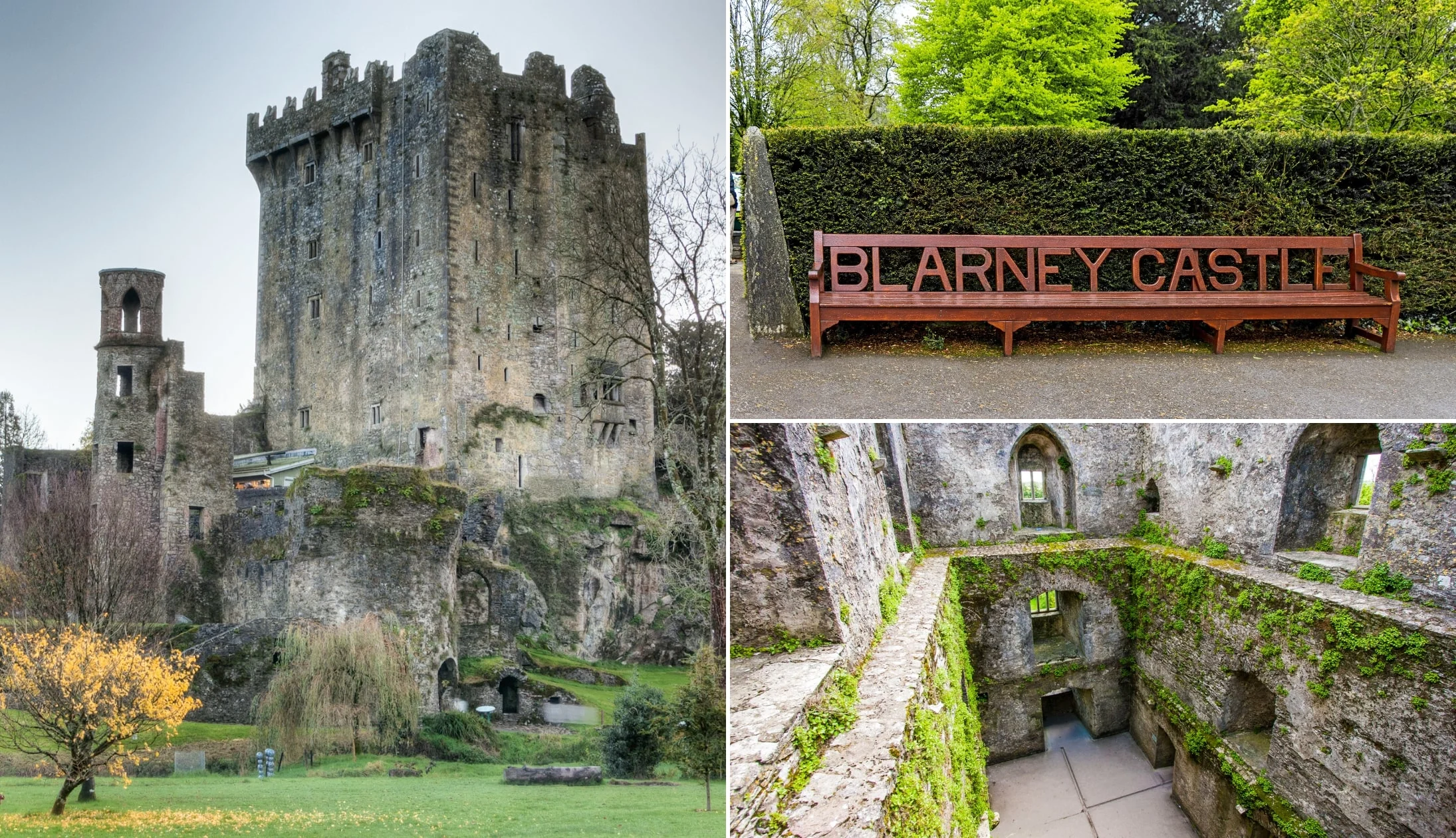
The first stronghold at Blarney was nothing more than timber, raised before 1200. Like many early Irish castles, it didn’t stand the test of time.
By 1210 a sturdier stone fort had taken its place. That too fell, leaving only fragments until the 15th century, when a powerful MacCarthy lord decided to start again.
Cormac Láidir’s Masterstroke
In 1446, Cormac Láidir MacCarthy, Lord of Muskerry, rebuilt Blarney on a grand scale. He was no stranger to construction – Kilcrea and Carrignamuck also bear his mark – but Blarney was his showpiece.
Its towering keep quickly became a fortress of influence, drawing comparisons with heavyweights like Trim Castle in Meath and the ecclesiastical might of the Rock of Cashel in Tipperary.
in Tipperary.
Siege and Seizure
Conflict was never far away. In 1646, during the Irish Confederate Wars, Parliamentarian forces under Lord Broghill stormed Blarney.
Though restored to the MacCarthys after the monarchy’s return, their control collapsed for good in the 1690s.
Donough MacCarthy, 4th Earl of Clancarty, was captured in the Williamite War, and his vast estates were stripped from the family.
From Judges to Governors
The castle then bounced between owners. Ireland’s Chief Justice, Sir Richard Pyne, held it briefly before Sir James Jefferyes, governor of Cork, secured the estate in the early 18th century.
His descendants later added Blarney House, a baronial mansion overlooking the lake.
Things to do at Blarney Castle and Gardens
There’s plenty more to experience at Blarney Castle other than the stone. In the section below, you’ll find some of the most unique and unusual attractions that the grounds boast.
From incredible views and poison gardens to the witch’s kitchen (yes, a witch!) and a murder hole, you’ll find something below to tickle every fancy.
1. The castle

The main attraction is, unsurprisingly enough, Blarney Castle, where the famous stone is located. Here’s what to expect (I’ll cover the stone further down:):
- The Great Hall: This vaulted chamber, with its massive 17th-century fireplace, was once the centre of castle life
- The Kitchen: Unusually perched on the top floor, the kitchen kept flames away from the heart of the castle
- The Dungeon: Carved into the rock below the tower, this chamber held the well and a tangle of now-sealed passages
- The Bawn: An 8-acre enclosure once wrapped around the castle, protecting livestock and tradesmen. The wall has long vanished, but its line survives along the Poison Garden
2. Blarney House

Built in 1874, Blarney House is a striking Victorian mansion overlooking the lake. Designed in the Scots baronial style by John Lanyon, it blends turrets, chimneys, and grand gables into a theatrical skyline.
Inside, a lofty hall, sweeping staircase, and portrait-lined walls reflect the Colthurst family’s long tenure.
Rooms have shifted purpose over time – the current library once served as a dining room, with meals hauled from the basement by a hidden turret lift.
3. The Witch’s Yew Tree

Deep in the Rock Close stands a yew believed to be more than six centuries old. Its roots grip a limestone outcrop that conceals the so-called Witch’s Kitchen, a curious 18th-century folly tied to tales of Blarney’s resident witch.
Local lore claims she was the first to reveal the secret of the stone’s eloquence. Twisted branches, dark evergreen needles, and its improbable age give the tree a presence that feels both otherworldly and enduring.
4. The gardens and grounds
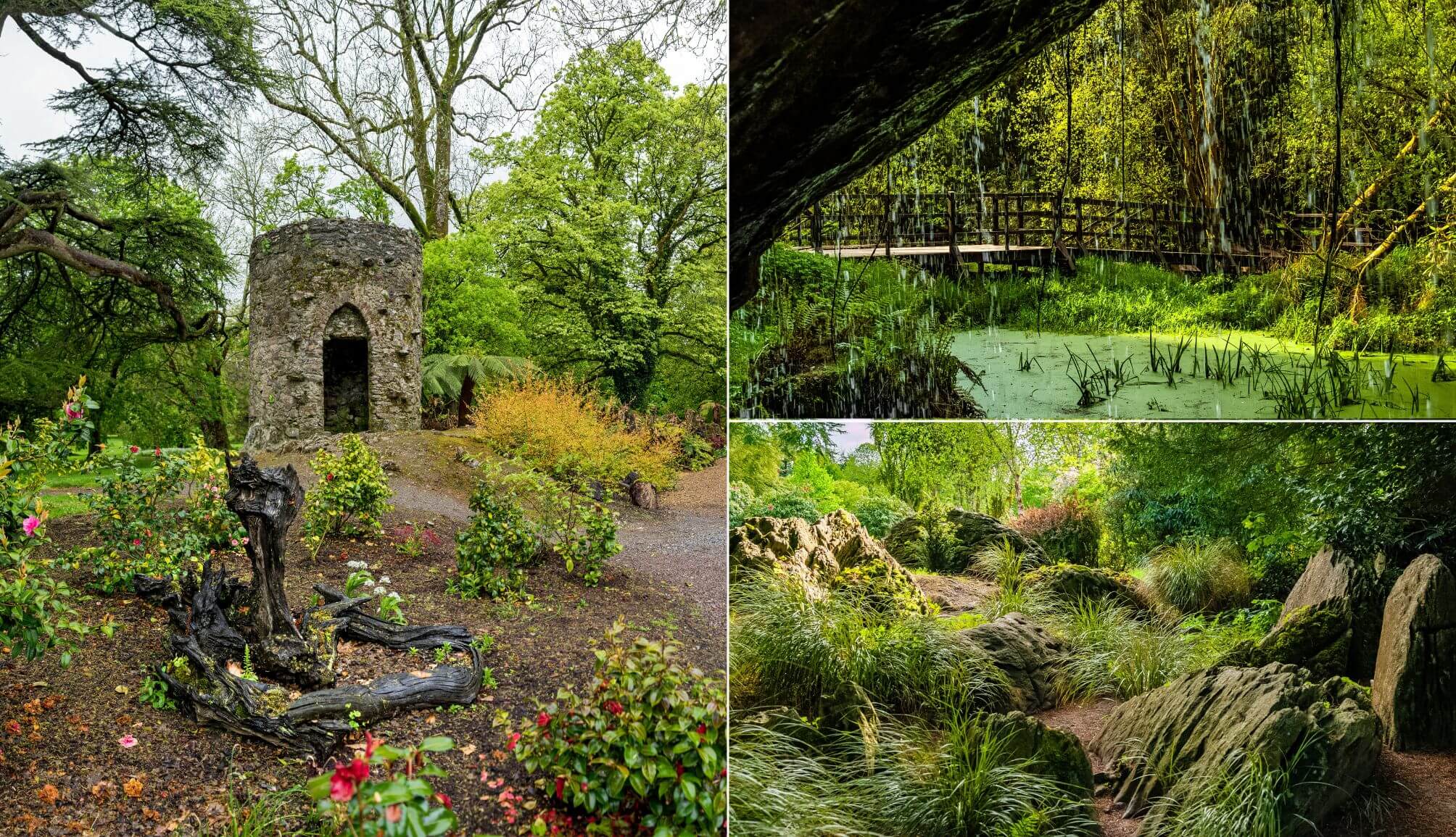
Most people arrive at Blarney to climb the castle, but the real treasure lies in its 60 acres of gardens and parkland. From the battlements you’ll see the full sprawl – a patchwork of woodland walks, waterways, and secret corners.
One of the most unusual spots is the Poison Garden, where plants so dangerous they need cage-like barriers grow within stone walls. Elsewhere, the grounds twist through places steeped in folklore.
The Rock Close mixes ancient yews and druidic boulders with stories of witches and faeries. In summer, long borders erupt in colour and scent, while in spring the azalea paths blaze bright.
Water features cut through the estate, boardwalks lead past giant-leaved plants, and the Seven Sisters standing stones recall a legend of family betrayal.
5. The Wishing Steps
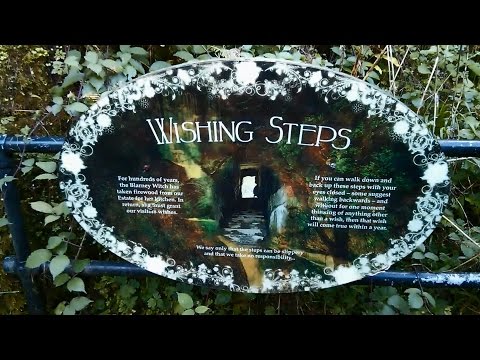
The Wishing Steps are missed by many that come to Blarney solely to visit the stone. The steps are found within an area known as ‘Rock Close’.
It’s said that if you can walk down and back up these steps with your eyes completely closed while making a wish (without stopping), your wish will come true within a year.
6. The Witch’s Kitchen

Yes, the Witch’s Kitchen. See there’s plenty more to this place than an aul stone! It’s believed that an area known as the ‘Witch’s Kitchen’ was home to the first Irish cave dwellers.
It’s said that, if you arrive at the kitchen in the early morning, you’ll find the remains of a fire that was lit by a witch late the night before.
7. The lake

Blarney Castle’s lake covers 22 acres and offers one of the estate’s most scenic trails.
The loop takes about 45 minutes at an easy pace, circling through woodland alive with red squirrels, jays, and the occasional flash of a kingfisher.
On the water itself you’ll often spot ducks, herons, and a resident family of swans. The path has plenty of quiet stops for views across the water, making it a calmer counterpoint to the busier castle battlements above.
The Blarney Stone
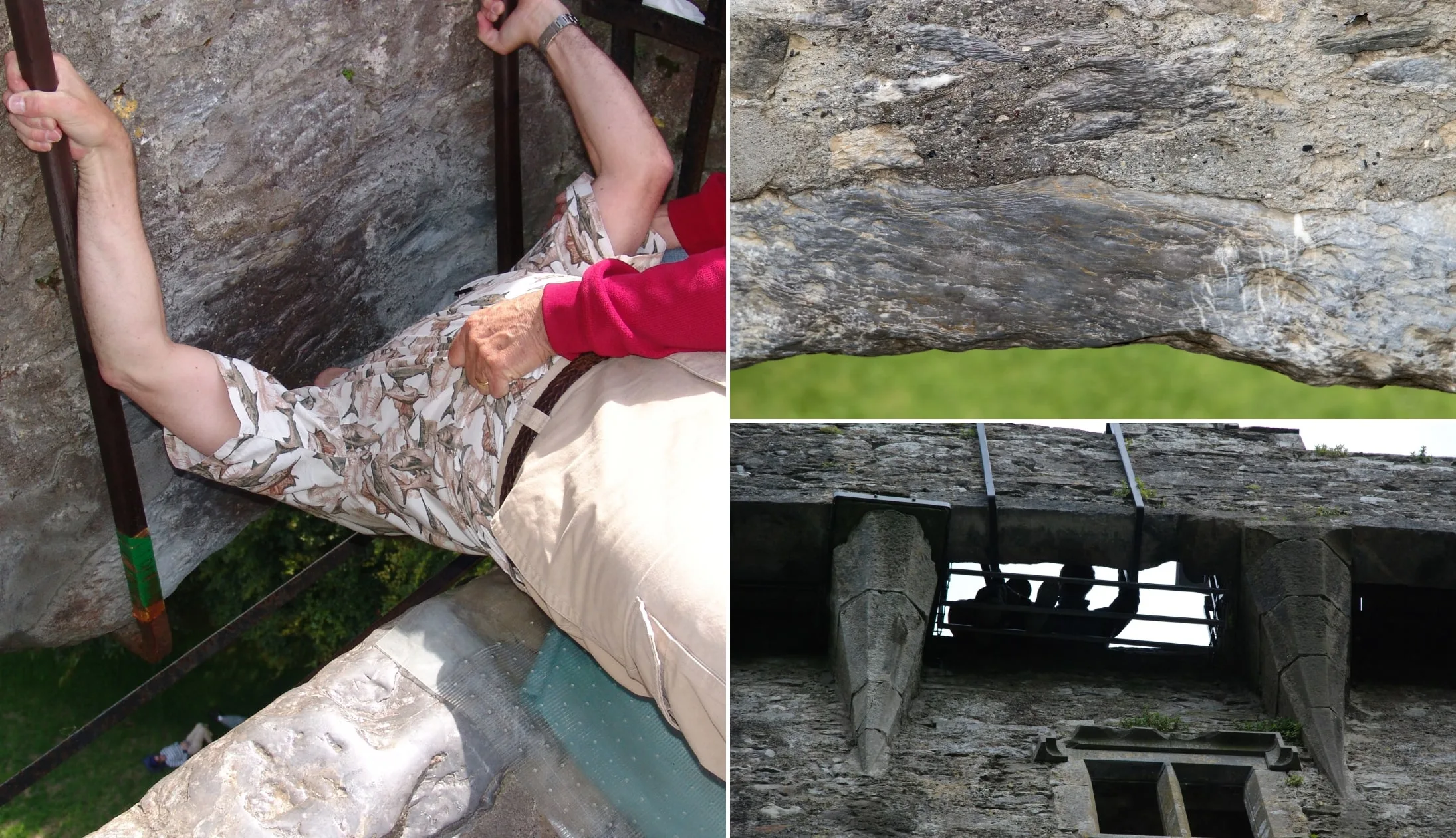
Ah, the Blarney Stone. It’s arguably one of the best-known (and oddest) attractions in Ireland with hundreds of thousands of people planting their lips on it every year.
For a whopping 200 years, Hollywood actors, literary greats and many a man, woman and child have travelled to Cork to with the intention of kissing the stone.
Kissing the Blarney Stone
Kissing the Blarney Stone is on the bucket list of many a tourist that’s visiting Ireland for the first time. Back in the day, visitors to the castle had to be held by the ankles and lowered down to kiss it.
Can you imagine trying to get insured for something like that now… Today, kissing the stone is an awful lot more straightforward – the stone is set into the wall right below the battlements.
In order to give it a big aul kiss, you need to lean backwards (you’ll have an iron railing to cling onto), stick your head under the stone wall (pictured above) and plant your lips on it.
The Stone of Eloquence and the Gift of the Gab
Legend has it that each of those that kiss the stone will be given the gift of eloquence. Now, if you’re scratching your head and wondering what this means, it means that those that kiss the stone will have the ability to talk sh*te (i.e. ‘BS’ in Irish slang).
However, the more appropriate translation for the Gift of the Gab is that those who possess it are said to be able to chat away easily and confidently.
Things to do nearby

One of the beauties of the castle is that it’s a short spin away from a clatter of other attractions, both man-made and natural, like:
- Cork City (20-minute drive): Explore Cork Gaol, the English Market, Elizabeth Fort, and Nano Nagle Place
- Kinsale (50-minute drive): Tackle the Scilly Walk, visit Charles Fort and see the cliffs at the Old Head of Kinsale
- Cobh (40-minute): Visit St. Colman’s Cathedral, discover Spike Island, try the Titanic Experience and see the Deck of Cards
Keith O’Hara has lived in Ireland for 35 years and has spent much of the last 13 creating what is now The Irish Road Trip guide. Over the years, the website has published thousands of meticulously researched Ireland travel guides, welcoming 40 million+ visitors along the way. In 2022, the Irish Road Trip team published the world’s largest collection of Irish Road Trip itineraries. Keith lives in Dublin with his dog Toby and finds writing in the 3rd person minus craic altogether.