
Some Irish boy names, like Oisín, echo the legends of Ireland’s folklore, while others were carried by High Kings such as Brian Boru, who fought the Vikings at Clontarf.
This guide has helped thousands of parents-to-be uncover Irish baby boy names that they’ve fallen in love with – it’s split into four sections:
- The most popular Irish boy names in Ireland: Based on statistics from the CSO
- Traditional Irish male names: Like Aodhán (meaning ‘little fire’)
- Modern first names: Like Connell and Oscar
- Rare Irish boy names: Ancient names that you likely won’t have heard
The most popular Irish boy names in Ireland
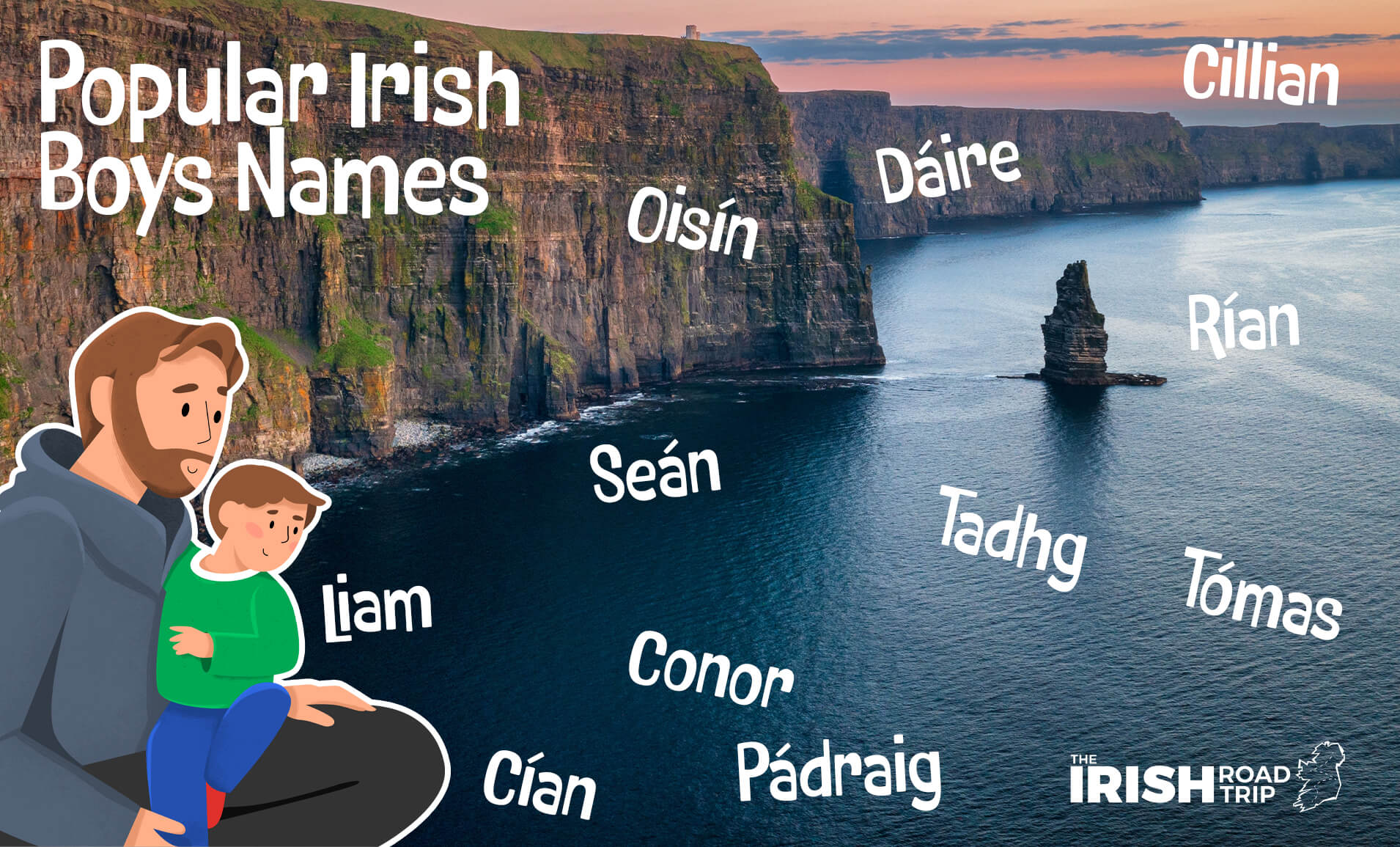
The first section of this guide looks at data from Ireland’s Central Statistics Office, highlighting the most popular Irish boy names given to newborns last year.
You’ll see familiar names like Oisín, but also a few surprises, such as Tadhg.
1. Rían
According to Ireland’s Central Statistics Office, Rían (Pronounced: ‘Ree-un’. Meaning: ‘Little king’. Anglicised: Ryan) was the most popular Irish boys name last year. This is an old name that gave birth the Irish surname Ó Riain.
2. Cillian
Cillian, (Pronounced: ‘Kil-ee-an’. Meaning: ‘Little church’, ‘strife’ or ‘bright-headed’. Anglicised: Kilian or Killian) is closely linked to early Christian Ireland. Its best-known bearer is Saint Kilian, born around 640, who led a mission from Kerry to modern Bavaria and was martyred in Würzburg in 689, later becoming the city’s patron saint.
3. Tadhg
Tadhg (Pronounced: ‘Tie-g’. Meaning: ‘Poet’ or ‘philosopher’) is one of the oldest Irish male names, and it goes back to the early medieval period and comes from a Proto-Celtic root linked to poets and storytellers. It was borne by many Gaelic kings between the 10th and 16th centuries, like Tadhg mac Conchobair, King of Connacht.
4. Fionn
Fionn (Pronounced: ‘Fyee-uhn’. Meaning: ‘White’ or ‘Fair-haired’. Anglicised: Finn) was most famously borne by the legendary warrior Fionn Mac Cumhaill, leader of the Fianna in the Fenian Cycle of Irish mythology. Beyond mythology, it has remained in steady use in Ireland and Scotland for centuries, and in 2024 it ranked 7th most popular Irish baby boys name.
5. Liam
Liam (Pronounced: ‘Lee-um’. Meaning: ‘Guardian’ or ‘Helmet of will’) stems from the old Irish Uilliam, itself adapted from the Norman William. Originally a shortened version, it developed into a standalone name in Ireland and later travelled abroad with emigrants.
6. Oisín
One of the most famous Irish names for boys, Oisín (Pronounced: ‘Ush-een’. Meaning: ‘Young deer’ or ‘fawn’) comes straight from Irish legend. He was the son of Fionn mac Cumhaill and Sadhbh, celebrated as both poet and warrior of the Fianna. His most famous tale tells of his journey with Niamh to Tír Na nÓg, the land of youth.
7. Tómas
Tomás (Pronounced: ‘Tho-mas’. Meaning: ‘Twin’. Anglicised: Thomas) is a name with deep biblical roots through Thomas the Apostle, one of the twelve disciples of Jesus. In Ireland it has been in steady use for centuries, with Tomás Mac Donnchadha, better known as Thomas MacDonagh, the poet and 1916 Easter Rising leader, among its most notable bearers.
8. Seán
Sean (Pronounced: ‘Shawn’. Meaning: ‘God is Gracious’. Anglicised: Shane and shawn) was brought to Ireland by the Normans in the 12th century. It became the most common Irish equivalent of John in Gaelic-speaking areas and was borne by countless figures in Irish history, like revolutionary Seán Mac Diarmada.
9. Pádraig
Pádraig (Pronounced: ‘Paw-drig’. Meaning: ‘Nobleman’. Anglicised: Patrick) comes from the Latin Patricius, meaning “of the patrician class.” Thanks to Saint Patrick, Ireland’s patron saint, it became one of the most popular Irish boy names. In Ireland, it also appears in other forms such as Pádraic, Páraic, and Páidí.
10. Conor
Conor (Pronounced: ‘Con-or’. Meaning: ‘Lover of wolves/hounds’) comes from the names Conchobhar and Conaire. Both appear throughout Irish legend, most famously with Conchobhar mac Nessa, King of Ulster.
11. Dáire
The name ‘Dáire‘ (Pronounced: ‘Daw-rah’. Meaning: ‘Fruitful’, ‘fertile’ or ‘oak tree’. Anglicised: Dara, Darragh and Darren) has been borne by many figures in Irish legend, including Dáire mac Fiachna, the cattle-lord of Ulster linked to the famous Brown Bull of Cooley. Some also connect the name to doire, the Irish word for “oak,” tying it to strength and the Dara Knot, a prominent Celtic symbol.
12. Cían
In mythology, Cían (Pronounced: ‘Kee-an’. Meaning: ‘Ancient’ or ‘enduring in Gaelic’) was the father of the Celtic god Lugh Lámhfhada, one of the central figures of the Tuatha de Dannan. Cían is consistently recognised as one of the most traditional Irish boy names.
Traditional Irish male names
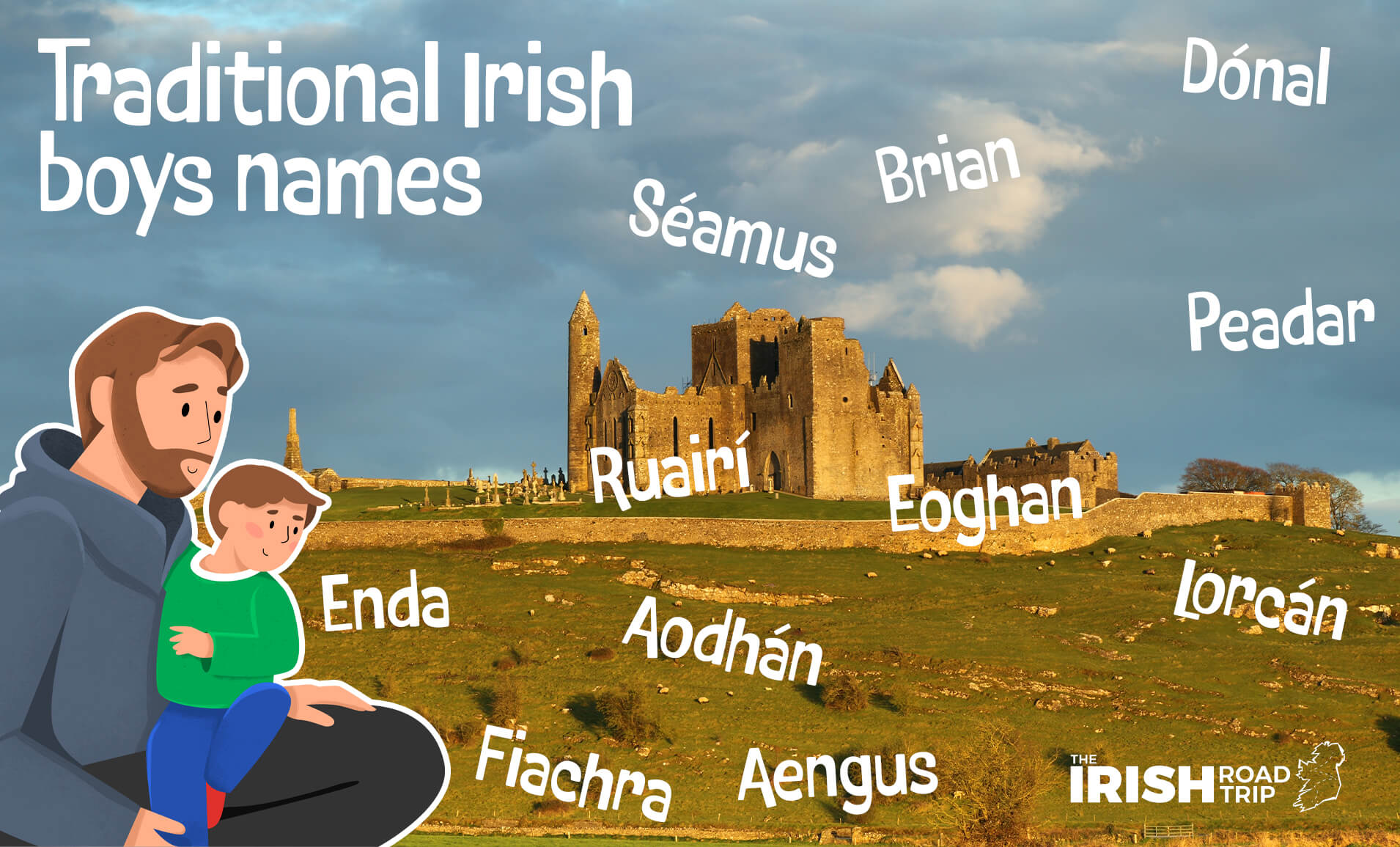
The next section explores traditional Irish boys names, drawing heavily on Fr Patrick Woulfe’s Sloinnte Gaedheal is Gall, one of the most trusted references on Irish names and surnames.
Here you’ll find names like Aodhán, linked to fire and early saints, Enda, remembered for his monastery on the Aran Islands, and Lorcán, one of many Irish names for boys linked to High Kings.
1. Aodhán
Aodhán (Pronounced: ‘Ay-dawn’. Meaning: ‘Fiery, bringer of fire or little fire’. Anglicised: Aidan and Aedan) comes from the old Irish male name Aodh, linked to the word for fire. The name runs deep in Irish history and legend – Áedán mac Gabráin ruled Dál Riata in the 6th century, and Saint Aidan of Lindisfarne became famous for spreading Christianity across Northumbria.
2. Enda
Enda (Pronounced: ‘En-dah’. Meaning: ‘Like a bird/bird-like’) is also often used as an Irish girls name. In legend, Enda appears as a warrior-king of Ulster, while history remembers Saint Enda of Aran, who around 484 founded one of Ireland’s earliest monastic settlements on Galway’s Aran Islands.
3. Lorcán
One of the more popular Irish baby boy names, Lorcán (Pronounced: ‘Lur-ken’. Meaning: ‘Little fierce one’) was carried by several Irish kings, including Lorcán, grandfather of the legendary High King Brian Boru.
4. Eoghan
Eoghan (Pronounced: ‘Owen’. Meaning: ‘Noble born’. Anglicised: Eoin and Owen) is one of the oldest Irish names for boys, with roots stretching back to early medieval dynasties. It’s tied to Niall of the Nine Hostages through his son Eógan, whose territory is what we now know as the Inishowen Peninsula in Donegal.
5. Ruairí
Ruairí (Pronounced: ‘Rur-ee’. Meaning: ‘Red-haired king’. Anglicised: Rory) is one of the more traditional Irish boys names and it tends to be given to boys born with red hair. The word ‘Ruadh’ means ‘red-haired’ in Irish while ‘Rígh’ means ‘King’.
6. Peadar
Peadar (Pronounced: ‘Pah-dar’. Meaning: ‘Stone/rock’. Anglicised: Peter) is the Irish form of the Greek Petros, meaning rock. It has been widely used in Ireland for centuries, often in religious contexts, thanks to Saint Peter the Apostle.
7. Dónal
Dónal (Pronounced: ‘Doh-nal’. Meaning: ‘World ruler or world wielder’. Anglicised: Donald) is the standard Irish form of the much older Celtic boys name, Domhnall. It has deep royal roots, carried by numerous kings and chieftains in Ireland and Scotland, including Domhnall mac Áedo, High King of Ireland in the 7th century.
8. Brian
The name Brian (Pronounced: ‘Bry-an’. Meaning: ‘High or noble’) likely comes from an Old Celtic word meaning “eminence.” The name surged in fame thanks to Brian Boru, the 10th-century High King of Ireland who broke Norse power in Ireland.
9. Séamus
Séamus (Pronounced: ‘Shay-mus’. Meaning: ‘One who supplants/grabs the heel’) is the Irish equivalent of ‘James’. It’s been a staple Irish baby boys name for centuries and it got a visibility boost from Irish WWE star Sheamus.
10. Conchobhar
Conchobhar (Pronounced: ‘Cruh-hoor’. Meaning: ‘Lover of canines’) is one of the oldest Irish boys names, rooted in myth and legend. Its best-known bearer is Conchobhar mac Nessa, king of Ulster, who ruled during the time of Cú Chulainn.
11. Aengus
Aengus (Pronounced: ‘Eng-gus’. Meaning: ‘One choice or one strength’) was a member of the warriors the Tuatha Dé Danann. He was a Celtic God of love and poetry and he was a protector of lovers and dreamers.
12. Fiachra
If you’re a fan of Irish folklore, you may recognise the name ‘Fiachra’ (Pronounced: ‘Fee-uh-kra’. Meaning: ‘Crow or raven’) from the famous story of the Children of Lir. Although it may look like one of the more intimidating Irish boys names to pronounce, it’s easily said – ‘Fee-uh-kra’.
13. Brendan
Brendan (Pronounced: ‘Bren-dan’. Meaning: ‘Prince or king’) originates from ‘Breandán’, a name that comes from an old Irish boys name ‘Brénainn’. In ancient Ireland, St. Brendan was an Irish monk who wrote ‘The Voyage of St. Brendan the Abbot.’ It recounts St. Brendan’s legendary journey in pursuit of a remarkable island.
14. Ciarán
Ciarán (Pronounced: ‘Keer-awn’. Meaning: ‘Little dark one or dark-haired one’) comes from the old Irish word ciar, meaning dark. The name is tied to Ciar, the early King of Ulster, and gained prominence through two influential saints – Ciarán the Elder of Seir Kieran and Ciarán the Younger of Clonmacnoise. Both were counted among the Twelve Apostles of Ireland, which cemented the name’s lasting presence in Irish tradition.
15. Cathal
The name ‘Cathal‘ (Pronounced: ‘Cah-hall’. Meaning: ‘Battle or rule’) comes from the word ‘Cath’, meaning ‘battle’, and ‘val’, meaning ‘rule’. It’s likely for this reason that is a name that was given to many Irish kings.
16. Diarmuid
If you’re looking for strong Irish boys names, look no further than ‘Diarmuid’ (Pronounced: ‘Deer-mid’. Meaning: ‘Without envy or free from envy’. Anglicised: Dermot). Although not too common outside of Ireland, versions of this name have been given to countless ancient Irish kings.
17. Cormac
Cormac (Pronounced: ‘Cor-mack’. Meaning: ‘Charioteer or raven’) is another traditional Irish baby boys name. In Irish, the word ‘Mac’ translates to ‘son’. However, it’s the ‘Cor’ part that’s unclear. It’s believed that ‘Cor’ relates to ‘Corb’ which is an old Gaelic word for ‘Wheel’. Others believe it is an old Irish word for ‘Raven’, which was seen by the Celts as a mythical creature.
18. Fearghal
In ancient Ireland, Fearghal (Pronounced: ‘Fer-ghal’. Meaning: ‘Man of valour’. Anglicised: Fergal) was a popular name among kings, poets, and chieftains, especially within the Uí Néill dynasty, one of the most powerful families in medieval Ireland.
19. Gearoid
In folklore, Gearoid Iarla (Pronounced: ‘Guh-rohd’. Meaning: ‘Strength of spear’. Anglicised: Gerald, Garrett and Gerard), the 3rd Earl of Desmond and Chief Justice of Ireland in 1367, was said to practice magic. Legend claims he still dwells beneath Lough Gur in Limerick, rising every seven years to circle the lake on a white horse.
20. Finbar
Finbar (Pronounced: ‘Finn-bar’. Meaning: ‘Fair-headed-one’) comes from the Irish Fionnbharr, just like the name Fionn. Its most famous bearer was Saint Finbar of Cork, who founded a monastery in the 6th century that later grew into the city of Cork. Today he’s still remembered as the city’s patron saint, with Gougane Barra and Saint Fin Barre’s Cathedral marking his legacy.
21. Rónán
The name Rónán (Pronounced: ‘Row-nawn’. Meaning: ‘Pledge’, ‘seal ‘and ‘promising oath’) comes from the Gaelic word ‘Rón’, which means ‘seal’. This name pops up in an old legend about a mother seal that is warned to avoid getting close to the land. However, a storm brings her ashore and she gets trapped and becomes a Selkie (a Celtic mythological creature). She marries a fisherman and has little ‘Rónáns’ (seals). The story ends with her finding her seal skin and escaping back to sea yet always keeping a watch on her family from the waves.
22. Senán
Senán (Pronounced: ‘Shen-awn’. Meaning: ‘Old’ or ‘wise’) is a name best known through St. Senán mac Geirrcinn (488–544), founder of the monastic settlement on Scattery Island off the Clare coast. His legacy made the name especially enduring in Munster, where it remains popular today.
23. Sé
Sé (Pronounced: ‘Sh-ay’. Meaning: ‘Admirable’. Anglicised: Shay) is a modern Irish boys name is thought to be the Irish variation of the Hebrew name ‘Shai’. It’s often considered for either boy’s or girl’s names, although it’s more common as a male name in Ireland.
24. Tiernan
Although it’s more commonly seen as a last name, Tiernan (Pronounced: ‘Teer-nin’. Meaning: ‘Lord’) has long been used as a first name. The name appears in medieval history through figures like Tighearnán Ua Ruairc, the 12th-century king of Bréifne. It comes from the Irish word tiarna, meaning “lord.”
Unique and unusual Irish boy names
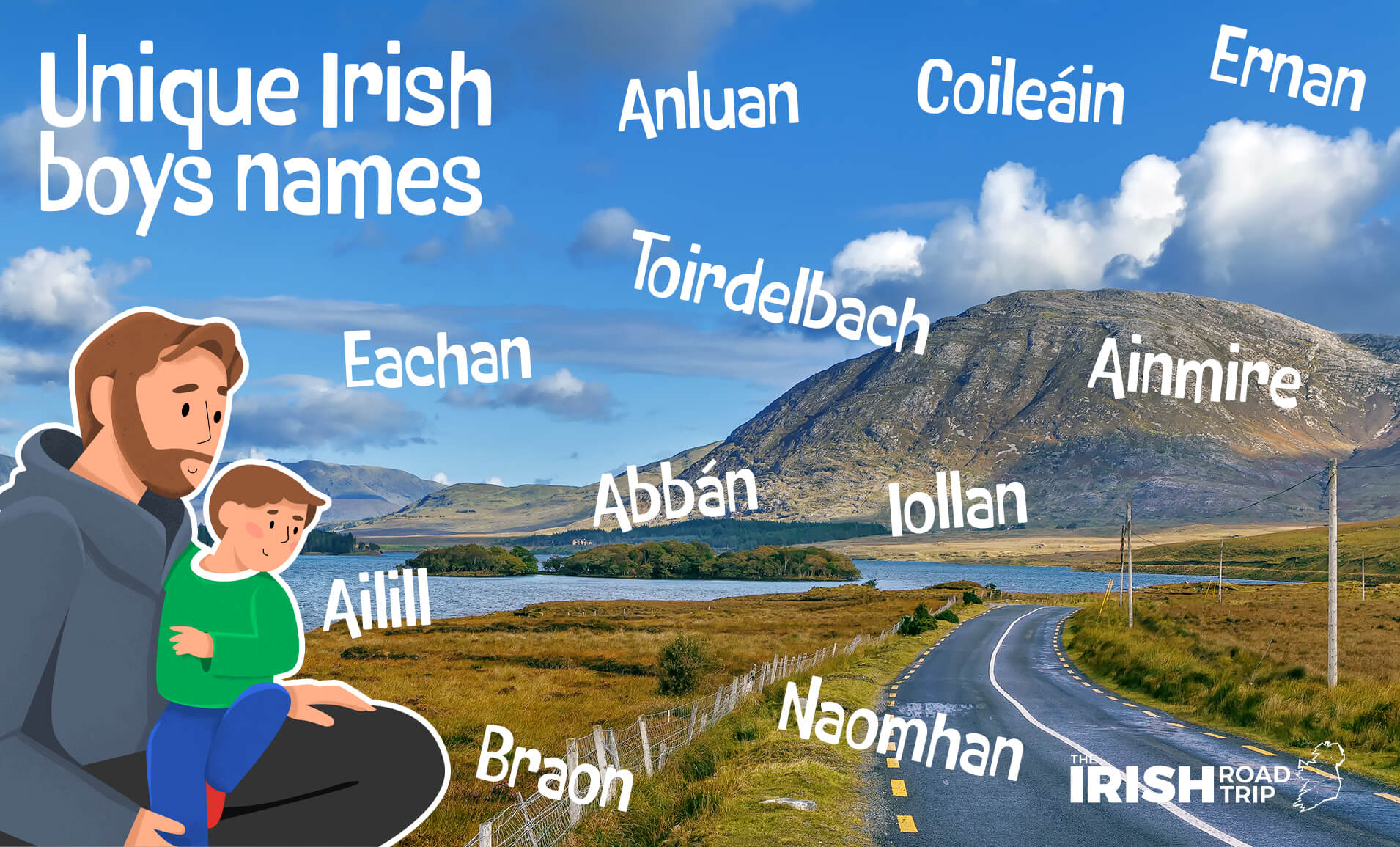
This part of the guide digs into unique Irish boys names you won’t hear every day, from Anluan, meaning “great warrior,” to Naomhan, tied to the word for “holy.”
These are the rare names that carry echoes of saints, kings, and even shapeshifters from old Irish lore.
1. Anluan
Anluan (Pronounced: ‘Ann-loo-an’. Meaning: ‘Champion, hero or warrior’) is one of the more unusual Irish boys names. Patrick Woulfe, in Irish Names and Surnames (1923), gives its meaning as “great warrior.” It’s rarely heard today, which makes it all the more appealing if you’re after something distinctive.
2. Toirdelbach
Toirdelbach (Pronounced: ‘Thur-lock’. Meaning: ‘Prompting or instigator’. Anglicised: Turlough) is a name that twists many a tongue. It comes from the Old Irish toirdhealbh, meaning “prompting” or “instigation,” and was carried by several powerful medieval kings.
3. Braon
Braon (Pronounced: ‘Bree-un’. Meaning: ‘Rain’ or ‘sorrow’) is a traditional Irish boys name. The surname Brennan comes from the Irish Ó Braonáin, meaning “descendant of Braonán,” with Braonán being the personal name at its root.
4. Eachan
Eachan (Pronounced: ‘Ach-an’. Meaning: ‘Horse lord’) is, strangely enough, anglicised as ‘Hector’. It comes from the Gaelic words each (horse) and donn (which can mean either ‘lord’ or ‘brown’).
5. Iollan
Iollan (Pronounced: ‘Yull-an’. Meaning: ‘One that worships a different God’) appears in medieval sources as a term once linked with pagans in Ireland. The name also survives in history through Iollan Mac an Leagha, a 15th-century Gaelic scribe and illuminator responsible for richly decorated manuscripts. It’s one of the more unusual Irish boys names and it’s one many struggle to pronounce.
6. Coileáin
Coileáin (Pronounced: ‘Quill-awn’. Meaning: ‘Pup or trickster’. Anglicised: Colin) is the anglicised form of the Irish Coileán and the Scottish Gaelic Cailean, both of which stem from the Old Irish cuilén meaning pup or whelp.
7. Naomhan
Naomhan (Pronounced: ‘Nee-van’. Meaning: ‘Holy’ or ‘Sacred’) is a rare Irish boys name that comes from the word noíb, meaning holy or sacred. The name was also borne by Saint Naomhán, son of Maolciarain. His feast was kept in mid-September.
8. Ainmire
Ainmire (Pronounced: ‘An-mir-eh’. Meaning: ‘Great lord’) is another name with strong links to ancient Ireland. Ainmuire mac Sétnai was a High King of Ireland from 566 to 569. He notably defeated Uí Néill’s high king at the Battle of Cúl Dreimne in 561.
9. Ailill
Ailill (Pronounced: ‘Ah-ill’. Meaning: ‘Beauty’) is one of the older Irish boys names that appears often in mythology and early history. Most famously, Ailill mac Máta was King of Connacht and husband of the legendary warrior queen Medb, who features in the Táin Bó Cúailnge (Cattle Raid of Cooley).
10. Donnacha
Donnacha (Pronounced: ‘Done-acka’. Meaning: ‘Dark chief’) is a very common name here in Ireland. In Irish legend, Donnacha was the name of a High King in Ireland. ‘Donn’ means brown/dark in Irish while ‘Chadh’ means noble or chief.
11. Abbán
Abbán (Pronounced: ‘Ab-awn’. Meaning: ‘Abbot or father’) is a beautiful Celtic boys name. According to Ireland’s national biographical dictionary, the name ‘Abbán’ is often interpreted as ‘little abbot’. However, it’s likely that the name originates from the diminutive form ‘abba,’ with a repeated middle consonant, influenced by the Irish girls name Ailbe.
12. Ernan
Ernan (Pronounced: ‘Air-nen’. Meaning: ‘Iron or wise one’) is a name that was given to several Irish Saints, one of which was St. Ernan, Son of Eogan who was a nephew of Saint Columba. Simply pronounced ‘Air-nen’, it’s one of several Gaelic boys names that means ‘Wise one’.
13. Caoimhín
Caoimhín (Pronounced: ‘Kwee-veen’. Meaning: ‘Noble at birth’. Anglicised: Kevin) is best known through Saint Kevin, who founded the monastery at Glendalough, one of Ireland’s most important early Christian sites.
14. Dáithí
Daithí (Pronounced: ‘Dah-hee’. Meaning: ‘Swiftness or nimbleness’. Anglicised: David) is a traditional Irish boys name that most famously borne by King Daithí, often remembered as the final pagan High King of Ireland before Christianity became dominant in the 5th century.
15. Desmond
Desmond (Pronounced: ‘Des-mond’. Meaning: ‘South Munster’) comes from the Irish Deas-Mhumhna, meaning South Munster. Rather than being a descriptive personal name, its roots lie in geography – it originally referred to people from the southern part of the province of Munster. The name later grew in prominence through the Earldom of Desmond, one of Ireland’s most powerful noble dynasties during the medieval period.
16. Éamonn
Éamonn (Pronounced: ‘Ay-mon’. Meaning: ‘Wealthy protector’. Anglicised: Eamon) is most famously associated with Éamon de Valera, one of the key revolutionary leaders of the early 20th century who went on to serve as Taoiseach and later President of Ireland.
17. Fintan
Fintan (Pronounced: ‘Fin-ten’. Meaning: ‘Little fair one or white-haired’) is arguably most suited as an Irish boys name if the new arrival is fair! In legend, Fintan mac Bóchra was said to be a shapeshifter who survived Ireland’s Great Flood, living for centuries and embodying wisdom and memory.
18. Deaglan
If you see your young lad giving Irish blessings from an altar in the future, Deaglán (Pronounced: ‘Dehk-lun’. Meaning: ‘Man of prayer or full of goodness’. Anglicised: Declan) is strongly associated with Saint Declán of Ardmore, one of the early Christian missionaries in Ireland who founded a monastery in Waterford in the 5th century, predating or working alongside Saint Patrick.
Modern Irish boys names

Here we look at modern Irish boys names – the ones still rooted in history but now popular in today’s world.
From Oscar, the grandson of Fionn Mac Cumhaill, to Connell, revived on TV screens in Normal People, these names bridge old Ireland with the present day.
1. Oscar
Oscar (Pronounced: ‘Os-kar’. Meaning: ‘Friend of deer’) comes from the Irish os (deer) and cara (friend). You may remember Oisín, the legendary poet-warrior – Oscar was his son and the grandson of Fionn Mac Cumhaill. The name has long carried associations with strength, kinship, and nature.
2. Art
Art (Pronounced: ‘Art’. Meaning: ‘Bear or champion’) is an old Celtic boys name that means ‘bear’ or ‘champion’. In ancient Ireland, this was a name steeped in royalty. Two High Kings of Ireland (Art mac Cuinn and Art mac Lugdach) bore this name.
3. Brady
Brady (Pronounced: ‘Bray-dee’. Meaning: ‘Large-chested or spirited’) comes from the Irish Brághadach. While it’s far more common as a surname in Ireland, it has taken off as a given name abroad, especially in the United States.
4. Bain
Bain (Pronounced: ‘Bay-ne’. Meaning: ‘White or fair’) is a name with several origins, appearing in Irish, Scottish, English, and even French contexts. One of the more common Gaelic boys names, it stems from words describing paleness or fairness of complexion.
5. Callum
Callum (Pronounced: ‘Cal-um’. Meaning: ‘Dove’) comes from the Latin columba, a word long associated with peace. The name gained ground in early Christian Ireland and Scotland thanks to Saint Columba, the missionary who founded the monastery on Iona in the 6th century.
6. Niall
Niall (Pronounced: ‘Ni-al’. Meaning: ‘Champion’) is one of the more popular Irish male names and it’s believed to come from the old Irish word ‘Niadh’, which means ‘Champion’. The name has strong royal ties, most notably through Niall of the Nine Hostages, a 5th-century High King of Ireland. It has gained popularity over the last decade, partly thanks to One Direction’s Niall Horan (discover more famous Irish people).
7. Lochlan
Lachlan (Pronounced: ‘Lack-lan’. Meaning: ‘Norway’ or ‘from the land of lakes’. Anglicised: Lachlan) is an old Gaelic name that appears frequently in early Irish literature. At first, it described a distant, almost mythical place across the sea; later it came to be used for Norway during the era of Viking contact.
8. Conán
Conán (Pronounced: ‘Cone-an’. Meaning: ‘Small hound or little wolf’) is an old Celtic boys name that’s tied to tales of the Fianna, the warrior bands of legend. One bearer, Conán mac Lia, appears in the stories as a member of this famed group, giving the name a lasting heroic edge.
9. Connell
Connell (Pronounced: ‘Con-il’. Meaning: ‘Hound or valour’) is an ancient Irish male name with deep clan ties. It comes from the Gaelic Conall, blending con (hound) with gal (valour, bravery). Modern audiences will recognise it from Paul Mescal’s character in Normal People, which helped spark a revival of the name internationally.
10. Naoise
Naoise (Pronounced: ‘Nee-sha’. Meaning: ‘Warrior’) is best remembered from the Ulster Cycle, one of Ireland’s oldest bodies of legend. He was the nephew of King Conchobar mac Nessa and the lover of Deirdre, whose beauty was said to rival all others.
11. Alroy
Alroy (Pronounced: ‘Ahl-roy’. Meaning: ‘Red haired’) is said to mean ‘red haired’ which will suit those of you with red-headed newborns!
12. Báire
Báire (Pronounced: ‘Ba-ry’. Meaning: ‘Fair-haired’. Anglicised: Barry) is both a given name and a surname in Ireland. It comes from older forms like Bairrfhionn and Finbarr, names built around the idea of light or fair hair.
13. Craig
Craig (Pronounced: ‘Cr-ay-g’. Meaning: ‘Rock’) comes from the Gaelic creag, a word used across Scottish, Irish, and Welsh traditions. The name was originally tied to rugged landscapes and craggy high ground, giving it a symbolic link to strength and resilience.
14. Colm
Colm (Pronounced: ‘Coll-um’. Meaning: ‘Dove’) is the Irish form of Columba, long used in Ireland out of respect for St Colm Cille (Columba of Iona). It’s related to Callum but isn’t a variant of Colin.
Rare Irish baby boys names
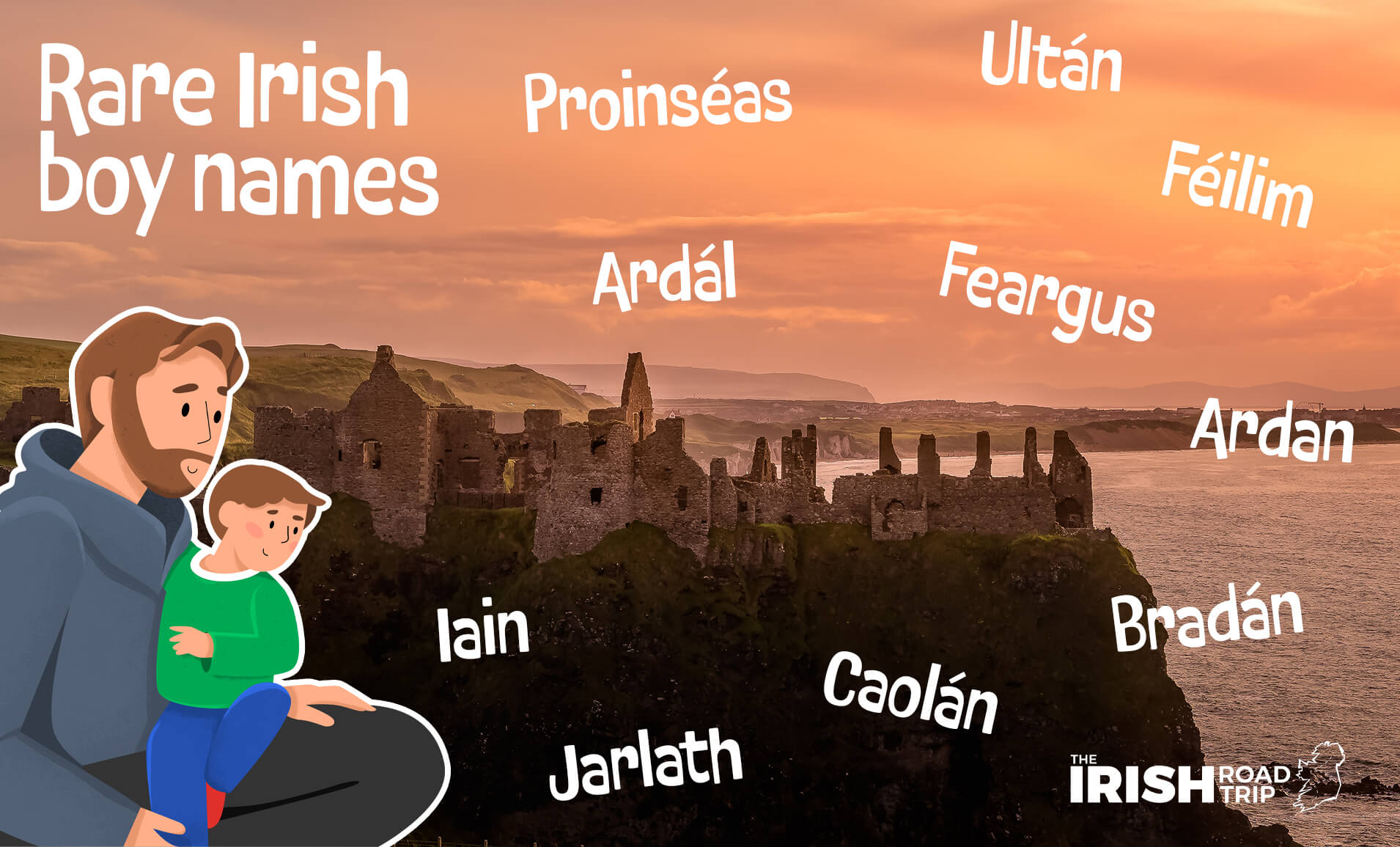
This part of the guide looks at rare Irish boys names – these are ones you’ll hardly ever hear, even in Ireland.
From Ardan of the Ulster tales to Bradán, tied to the Salmon of Knowledge, these names carry deep history but remain strikingly uncommon today.
1. Ardan
In Celtic mythology, Ardan (Pronounced: ‘Ar-dawn’. Meaning: ‘High aspiration or high ambition’) was one of the Sons of Uisnech. In the tale of Deirdre, Ardan and his brothers Naoise and Ainnle helped Deirdre flee to Scotland.
2. Bradán
Bradán (Pronounced: ‘Bra-dawn’. Meaning: ‘Salmon’. Anglicised: Bradan and Braden) comes from the Irish Ó Bradáin, meaning descendant of Bradán. While you won’t often hear it as a given name in Ireland, variants like Braden are widely used in the United States. In Irish tradition, the salmon carries strong symbolic weight – think of the Salmon of Knowledge.
3. Caolán
Caolán (Pronounced: ‘Kway-lawn’. Meaning: ‘Slender or fine’. Anglicised: Kelan, Keelan and Kealan) comes from the Irish word caol, meaning narrow or slender. While traditional in origin, it’s often given modern spellings like Keelan or Kelan, which are easier for non-Irish speakers.
4. Anrai
Anrai (Pronounced: ‘On-ree’. Meaning: ‘Rules the home/estate’. Anglicised: Henry) is the Irish version of ‘Henry’. Although the spelling may intimidate some, it’s simply pronounced ‘Awn-ree’.
5. Iain
Iain (Pronounced: ‘Ee-in’. Meaning: ‘God is gracious’) is the Gaelic form of John, widely used in both Ireland and Scotland. It stems from the Hebrew Yohanan, carried into Gaelic through early Christian influence.
6. Jarlath
Jarlath (Pronounced: ‘Jar-lath’. Meaning: ‘Prince’, ‘leader’ or ‘tributary lord’), is another of the traditional Irish male names and it’s one that you don’t hear too often. One of the most famous Jarlaths was Saint Jarlath, an Irish priest from Connacht who founded the Archdiocese of Tuam in Galway.
7. Ardál
Ardál (Pronounced: ‘Ar-dahl’. Meaning: ‘High valour’) is another of the old Irish boys names that comes from art (bear) and gal (valour). Bears held symbolic weight in Celtic symbolism, linked to strength, courage, and protection, which explains the name’s enduring associations.
8. Feargus
Feargus (Pronounced: ‘Fir-gus’. Meaning: ‘Strong one or masculine one’. Anglicised: Fergus) is among the oldest Gaelic names, long used in both Ireland and Scotland. Its roots stretch back to early myth and history, with kings, warriors, and saints carrying the name over the centuries. Simple to pronounce and heavy with tradition, it has endured as a symbol of strength.
9. Féilim
The name Féilim (Pronounced: ‘Fail-em’. Meaning: ‘Beauty, ever good and constant’) is often overshadowed by its anglicised cousin Felix, but in Ireland it has deep royal roots. High Kings like Felim Ua Conchobair of Connacht carried the name, giving it a long association with leadership and steadiness.
10. Ultán
Ultán (Pronounced: ‘Ul-tan’. Meaning: ‘Ulsterman’), which means ‘Ulsterman’ is a name rooted in Ireland’s northern province. In the early medieval period, Ulster sat at the centre of the Gaelic world, linking Ireland, Scotland, and the Isle of Man.
11. Proinséas
Proinséas (Pronounced: ‘Prun-shas’. Meaning: ‘Little French man’) is the Irish form of Francis, best known through St Francis of Assisi. Rarely heard in Ireland today, it stands out for its uniqueness, though its spelling and pronunciation can trip up those unfamiliar with Irish names.
12. Canice
Canice (Pronounced: ‘Can-is’. Meaning: ‘Handsome’) is the anglicised form of two old Gaelic names. It’s remembered today through St Canice, a 6th-century Irish saint whose legacy includes St Canice’s Cathedral in Kilkenny. Though uncommon as a first name now, it carries deep historical and ecclesiastical weight.
13. Conlaoch
Conlaoch (Pronounced: ‘Kun-luck’. Meaning: ”Hero’ or ‘chief”) is one of the ancient Irish boys names bound to legend. In the Ulster Cycle, Conlaoch was the son of Cú Chulainn, Ireland’s most formidable warrior – a figure whose tragic fate mirrored the heroic but brutal world of early Irish myth.
14. Conal
Conal (Pronounced: ‘Coh-nal’. Meaning: ‘Strong as a wolf’) was a name carried by warriors and nobles in early Ireland. The best-known was Conall Cernach, a champion of the Ulster Cycle, remembered for his crooked neck and his grim habit of sleeping with the heads of his enemies beneath his knee.
15. Colmán
Colmán (Pronounced: ‘Cohl-a-man’. Meaning: ‘Little dove’) is closely related to the name Colm and was widely used among early Irish saints. One of the most prominent was St Colmán of Cloyne, a 6th-century monk and poet whose writings gave him a lasting reputation for extraordinary verse.
16. Nechtan
Nechtan (Pronounced: ‘Nye-ach-tan’. Meaning: ‘Clean’ and ‘Pure’) is tied to one of Ireland’s oldest origin tales. In Irish folklore, Nechtan was the guardian of a sacred well whose waters gave rise to the River Boyne, one of the most storied rivers in Irish history.
17. Odhrán
Odhrán (Pronounced: ‘Oh-ran’. Meaning: ‘Pale green’. Anglicised: Oran) is a traditional name that has seen wider use in its simplified form, Oran. It appears in early Christian history, most notably with St Odhrán, said to be one of St Columba’s companions in the 6th century.

Keith O’Hara has lived in Ireland for 35 years and has spent much of the last 13 creating what is now The Irish Road Trip guide. Over the years, the website has published thousands of meticulously researched Ireland travel guides, welcoming 40 million+ visitors along the way. In 2022, the Irish Road Trip team published the world’s largest collection of Irish Road Trip itineraries. Keith lives in Dublin with his dog Toby and finds writing in the 3rd person minus craic altogether.