Classiebawn Castle Guide: History and Viewpoints

With Benbulben rising behind it and the Atlantic crashing against the coastline below, Classiebawn Castle enjoys one of the most spectacular settings of any castle in Ireland.
Standing on the Mullaghmore Peninsula since 1874, the castle has witnessed everything from British prime ministers and the Mountbatten family to one of the defining moments of the Troubles.
Although the castle itself is privately owned, there are several excellent viewpoints nearby where you can admire one of Sligo’s most recognisable landmarks.
About Classiebawn Castle

So, you can’t visit Classiebawn Castle in Mullaghmore, but you can see it from various places on the peninsula. Here are some quick need-to-knows.
1. Location
You’ll find Classiebawn Castle in Sligo, on the Mullaghmore Peninsula. It’s a 25-minute drive from Sligo Town and Rosses Point and a 40-minute drive from Strandhill.
2. Privately owned
Despite its popularity, this is one of numerous Irish castles that isn’t open to visitors. It sits within a private estate spanning around 3,000 acres and remains a private residence, so you’ll only be able to admire it from outside the grounds.
3. Managing expectations
The first time I went to see Classiebawn Castle, I had the famous postcard view in my head – the castle sitting directly beneath Benbulben (see the photos below). What I hadn’t realised was that most of those images were taken using zoom lenses by professional photographers. In reality, the castle sits much further from the road than many people expect.
4. The viewpoints
You’ll get a good view from the road towards Mullaghmore Head, but don’t arrive expecting the castle to dominate the landscape. It’s a more distant view, with Classiebawn framed by Benbulben in the background, and it’s easily one of the most photographed scenes in County Sligo (I’ve created a map for you below with links to the viewpoints on Google Maps).
5. The Crown
Classiebawn received a fresh wave of attention after appearing in Season 4 of The Crown, where it doubled as the Mountbatten family home. Given Lord Mountbatten’s close connection with the estate, it was a fitting choice of filming location.
The history of Mullaghmore Castle

From a confiscated estate and a British Prime Minister to the Mountbatten family and one of the most shocking events of the Troubles, Classiebawn Castle has seen more than its fair share of history.
Like many Irish castles, Classiebawn passed through many hands over the years. In the section below, you’ll get a speedy insight into the history of the castle, many of those who owned it, and how you can see it today.
The land before the castle
Long before the castle appeared on the Mullaghmore skyline, this land belonged to the O’Connor Sligo family. Like countless estates across Ireland, it was confiscated by the English Parliament during the Plantation era and handed to Sir John Temple.
Over the following centuries, the estate stayed within the Temple family before eventually passing to Henry John Temple, better known as the 3rd Viscount Palmerston.
Building one of Ireland’s finest country houses
Palmerston wasn’t just a wealthy landowner – he also served twice as British Prime Minister. In the 1860s, he commissioned Dublin architect James Rawson Carroll to design a grand country house overlooking the Atlantic.
Built in the Scottish Baronial style, the castle was constructed using sandstone shipped across by sea from County Donegal. Palmerston died in 1865 before seeing his vision completed, and it wasn’t until 1874 that his stepson, William Cowper-Temple, finally finished the castle.
The Mountbatten years
The estate changed hands several times before eventually being inherited by Edwina Mountbatten in 1939.
She and her husband, Lord Louis Mountbatten – the last Viceroy of India and uncle of Prince Philip – modernised the castle by installing electricity and mains water.
The tragedy that made headlines around the world
Classiebawn Castle is forever linked with the events of 27 August 1979. While staying at the castle, Lord Mountbatten lost his life following an IRA attack on his fishing boat just off the coast of Mullaghmore.
The attack also claimed the lives of his 14-year-old grandson Nicholas Knatchbull, local teenager Paul Maxwell and Lady Brabourne. The assassination dominated headlines around the world and remains one of the defining events of the Troubles.
Who lives in Classiebawn Castle today
In 1991, businessman Hugh Tunney bought the castle after leasing it for several years and carried out extensive restoration work on both the house and its estate.
Today, Classiebawn remains privately owned and isn’t open to visitors. Thankfully, you don’t need to step inside to appreciate it.
Classiebawn Castle viewpoints

There are three main viewpoints for Classiebawn Castle:
- Viewpoint 1: From this section of road as you follow the Mullaghmore Loop
- Viewpoint 2: The main viewpoint right next to the coast (be careful pulling in if you’re driving)
- Viewpoint 3: From over on Trawalua Strand (the castle is above you)
Things to do nearby

One of the beauties of Classiebawn Castle is that it’s a short spin away from many of the best places to visit in Sligo.
Below, you’ll find a handful of things to see and do a stone’s throw from the castle (plus places to eat and where to grab a post-adventure pint!).
1. Mullaghmore Beach (5-minute drive)

The beautiful Mullaghmore Beach is a short, 5-minute spin from the castle and it’s a great spot for a saunter along the sand. If you fancy a bit of food, the Pier Head Hotel is a solid option. Streedagh Beach is also just 15 minutes away.
2. Bundoran (15-minute drive)

Bundoran (Donegal) is another hand spot to visit. There’s plenty of things to do in Bundoran and there are several great restaurants in Bundoran if you’re feeling peckish.
3. Gleniff Horseshoe (15-minute drive)
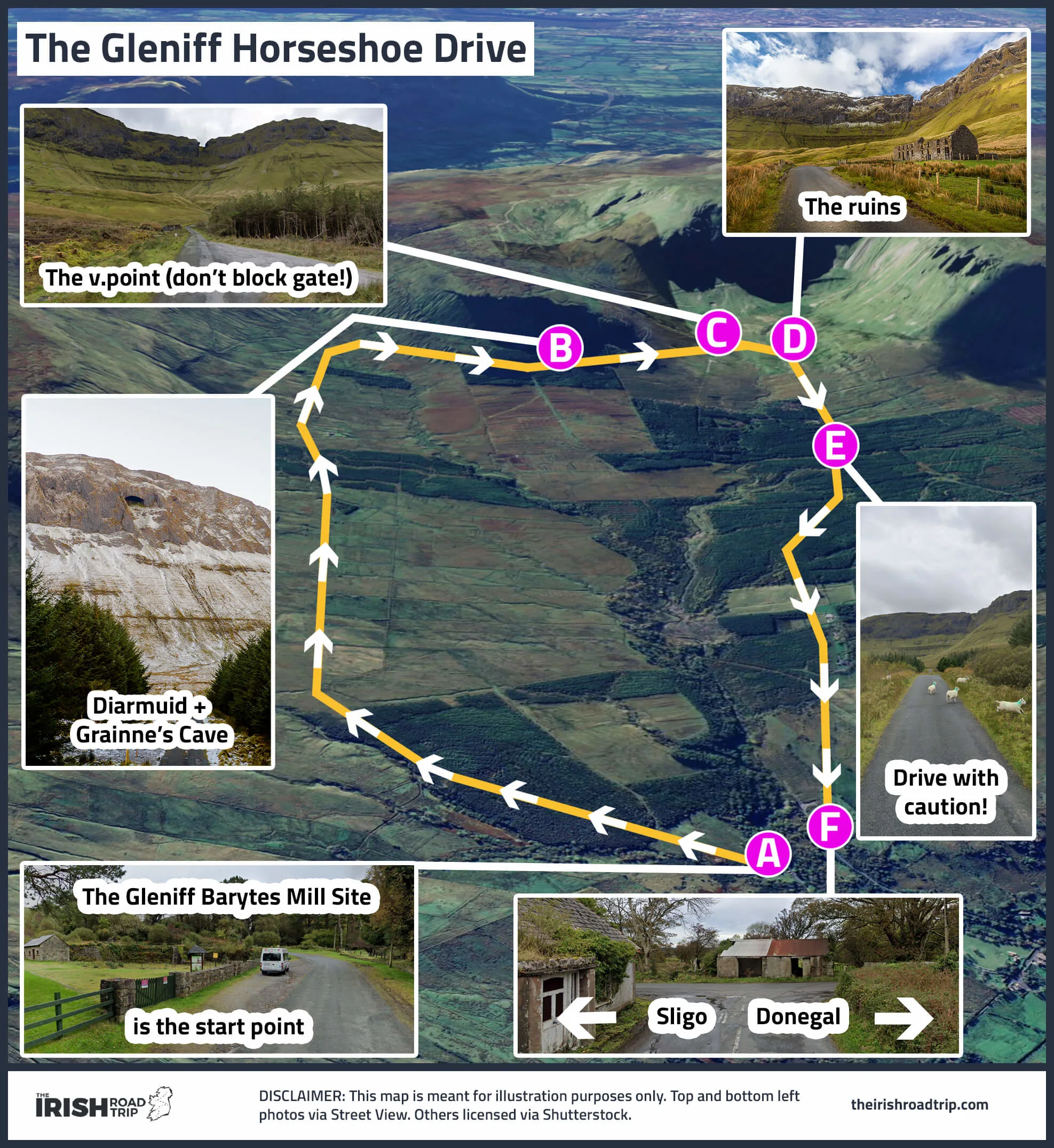
The Gleniff Horseshoe Drive (or walk/cycle) is well worth doing. It’s a short drive (20 – 30 mins max) and a decent, 2.5 hour walk. Here’s a guide to it.
4. Waterfalls (25-minute drive)
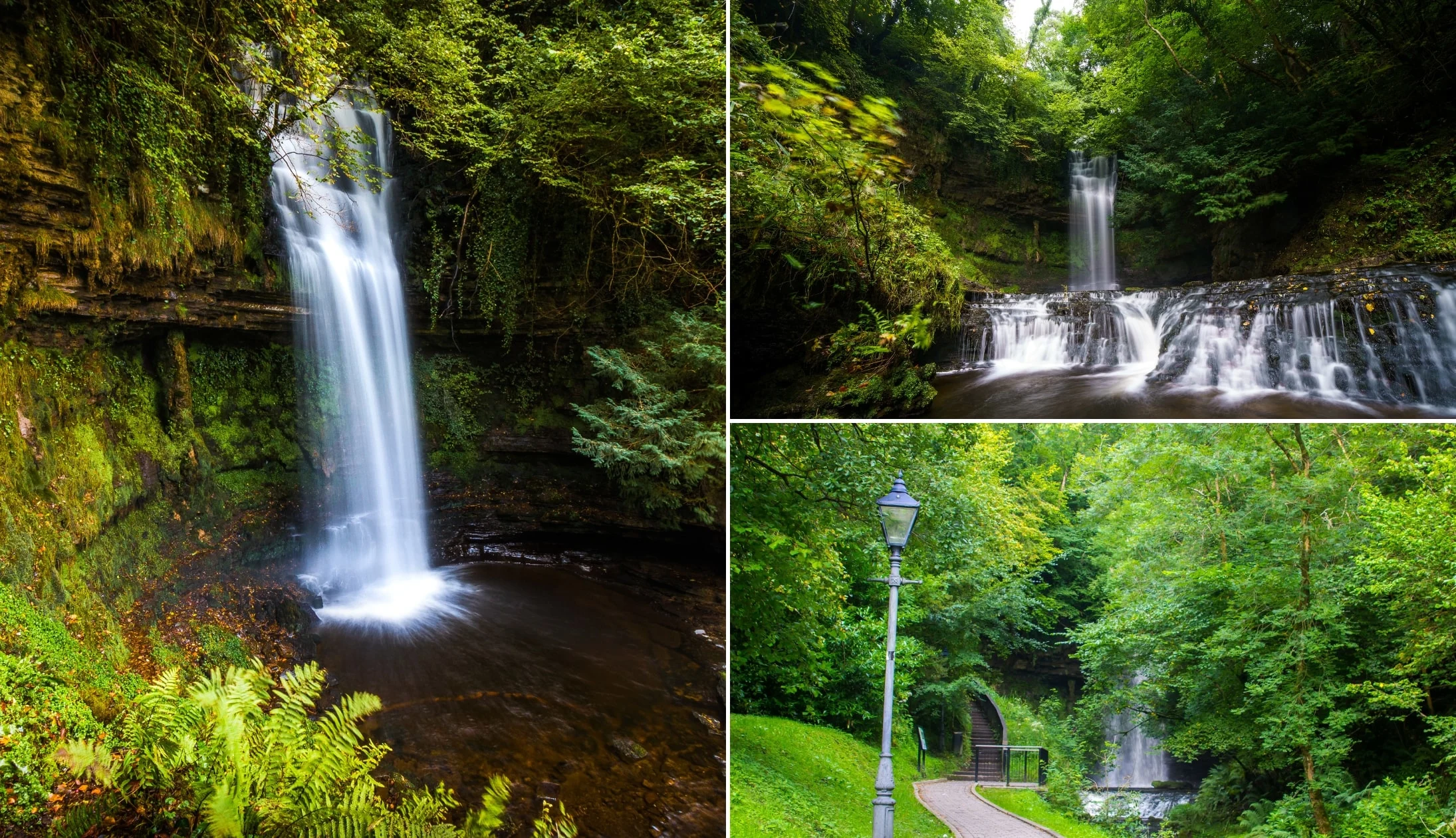
The incredible Devil’s Chimney (only runs after heavy rain) and the brilliant Glencar Waterfall (Leitrim) are a short spin from Mullaghmore Castle. There are plenty of other walks in Sligo close by, too!
Keith O’Hara has lived in Ireland for 35 years and has spent much of the last 13 creating what is now The Irish Road Trip guide. Over the years, the website has published thousands of meticulously researched Ireland travel guides, welcoming 40 million+ visitors along the way. In 2022, the Irish Road Trip team published the world’s largest collection of Irish Road Trip itineraries. Keith lives in Dublin with his dog Toby and finds writing in the 3rd person minus craic altogether.