Clare Island: A Guide To Mayo’s Hidden Gem

Clare Island sits at the mouth of Clew Bay in County Mayo, guarding the Atlantic approach just a short ferry ride from Roonagh Pier near Louisburgh. It’s a mountainous island with a permanent population of around 140 people, a single harbour, and one straightforward way in and out by boat, which shapes everything about a visit here.
Immortalised in song by the Saw Doctors and in the Michael Morpurgo book, The Ghost of Grania O’Malley, Clare Island is one of Mayo’s true hidden gems.
There is plenty to see and do on the island and while many people enjoy a visit on a day trip, I’d recommend a few nights’ stay to take advantage of all that peace, quiet and scenery.
About Clare Island in Mayo
A visit to Clare Island isn’t as straightforward as some of the other Mayo attractions, but it’s well worth the trip over from Roonagh Pier. Here are some need-to-knows.
1. Location
The island can be found three miles off the west Mayo coastline and it’s accessed via the Clare Island Ferry.
2. Getting to the island
To travel to the island, take the Clare Island Ferry from Roonagh Quay (west of Louisburgh) to the island. The journey takes 15 – 20 minutes and allows you to take in the area’s gorgeous scenery – Achill Island, Croagh Patrick and the Nephin mountain range.
3. Gráinne O’Malley’s home
Clare Island (known as Oileán Chliara in Irish) is a mountainous island that guards the entry to Clew Bay and is well-known for being the home of the 16th century pirate queen Gráinne O’Malley.
4. History
Clare Island was part of the O’Malley family’s lands and the remains of an old watch tower can be found close to the pier on the island’s east side. The abbey was founded by the family and may be the site of Grace O’Malley’s tomb. In the late 16th century, a ship from the Spanish Armada was wrecked on the islands, its soldiers and sailors killed by the O’Malleys. A lighthouse was established on the island in 1806, later taken out of service in 1965.
5. In culture
The Saw Doctors’ track Clare Island from the Same Oul’ Town album refers to the peaceful nature of the island, and it was also the setting for the 1987 Bob Quinn’s film Budawanny. He also recorded a documentary there (The Island) in 1966.
How to get to Clare Island

So, as you’ll have probably guessed at this stage, you need to take the Clare Island Ferry to get across to the island. Don’t let this put you off, as it’s nice and straightforward.
How long it takes
The Clare Island Ferry leaves from Roonagh Quay (west of the town of Louisburgh) and is a mere ten-minute journey.
How much it costs
Adults pay €17 return, students and ages 13 – 18 pay €12, and children 5 – 12 pay €8. Under 5s and OAPs with an Irish Travel Pass or NI SmartPass travel free.
When it leaves
There are separate summer and winter timetables.
- From May to September: Sailings are most frequent, with multiple departures daily and extra crossings at weekends
- From October to April: A daily service operates, weather permitting.
Things to do on Clare Island
There’s plenty of things to do on Clare Island that make it well worth a day trip and, as you’ll see when you get down to the pubs section, well worth a stop-over.
Below, you’ll find everything from walks and the Clare Island Lighthouse to a very unique heritage tour and more.
1. Try one of the looped walks

Clare Island has a varied terrain, which makes it terrific for walking. There are some spectacular cliffs where you will see large numbers of nestling seabirds, and there are hills, bogs and woodland to explore.
The walks take in all aspects of the island’s rich history – from the archaeological remains of prehistoric times to the medieval paintings that can be seen in the abbey.
Old potato ridges that can be seen clearly when the sun sets mark the lives of the former population, as Clare Island was once home to 1,600 people.
2. Soak up some history at the Abbey

Clare Island Abbey, officially St. Brigid’s Abbey, is a 15th-century Cistercian cell on the south of Clare Island and one of the island’s most important historic sites.
It’s best known for its rare surviving medieval wall paintings, still visible inside the church.
The abbey contains tombs of the O’Malley clan, including a possible burial place of Gráinne O’Malley. It’s unguided, open daily in summer, with key access via the local shop in winter.
3. Give the Heritage Tour and whiskey tasting a bash

The Heritage Tour and whiskey tasting is one of the most worthwhile things you can do on Clare Island if you want context, not just scenery.
You travel over on the 10:35am ferry from Roonagh Pier and are met at the island by Carl O’Grady, a local islander and founder of Clare Island Whiskey.
The walk to Gráinne O’Malley’s castle takes about a minute. The talk covers island history, seafaring life, and the O’Malley legacy, before linking it back to the whiskey project.
The optional barrel-aged-at-sea tasting adds real substance. Expect about 2 hours total.
4. Ramble along the Archaeological Trail

Before the O’Malleys established their claim to the island, prehistoric populations made it their home, as is shown by the 53 Bronze Age mounds on Clare Island.
Radiocarbon dating techniques have aged two of them to 2000 BCE, and two to about 1000 BCE, indicating a continuous population for centuries. The Archaeological Trail explores these ancient monuments.
5. Step back in time at Granuaile’s Castle

Granuaile’s Castle is one of the more unique castles in Ireland history-wise. It sits beside the pier on the east coast of Clare Island and is one of the first things you’ll see when you step off the ferry.
Built in the 16th century by the O’Malley clan, it was a stronghold of Gráinne Ní Mháille, the Pirate Queen of Connacht.
This compact tower house once controlled access to Clew Bay and formed part of a wider network that included Rockfleet and Carrickkildavnet.
In the 1820s it was repurposed as a police barracks. Today, it’s a quick, worthwhile stop that adds real historical weight to a Clare Island visit.
Clare Island accommodation
There’s a decent bit of Clare Island accommodation on offer, from camping and B&Bs to the Clare Island hostel and much more.
Clare Island Lighthouse
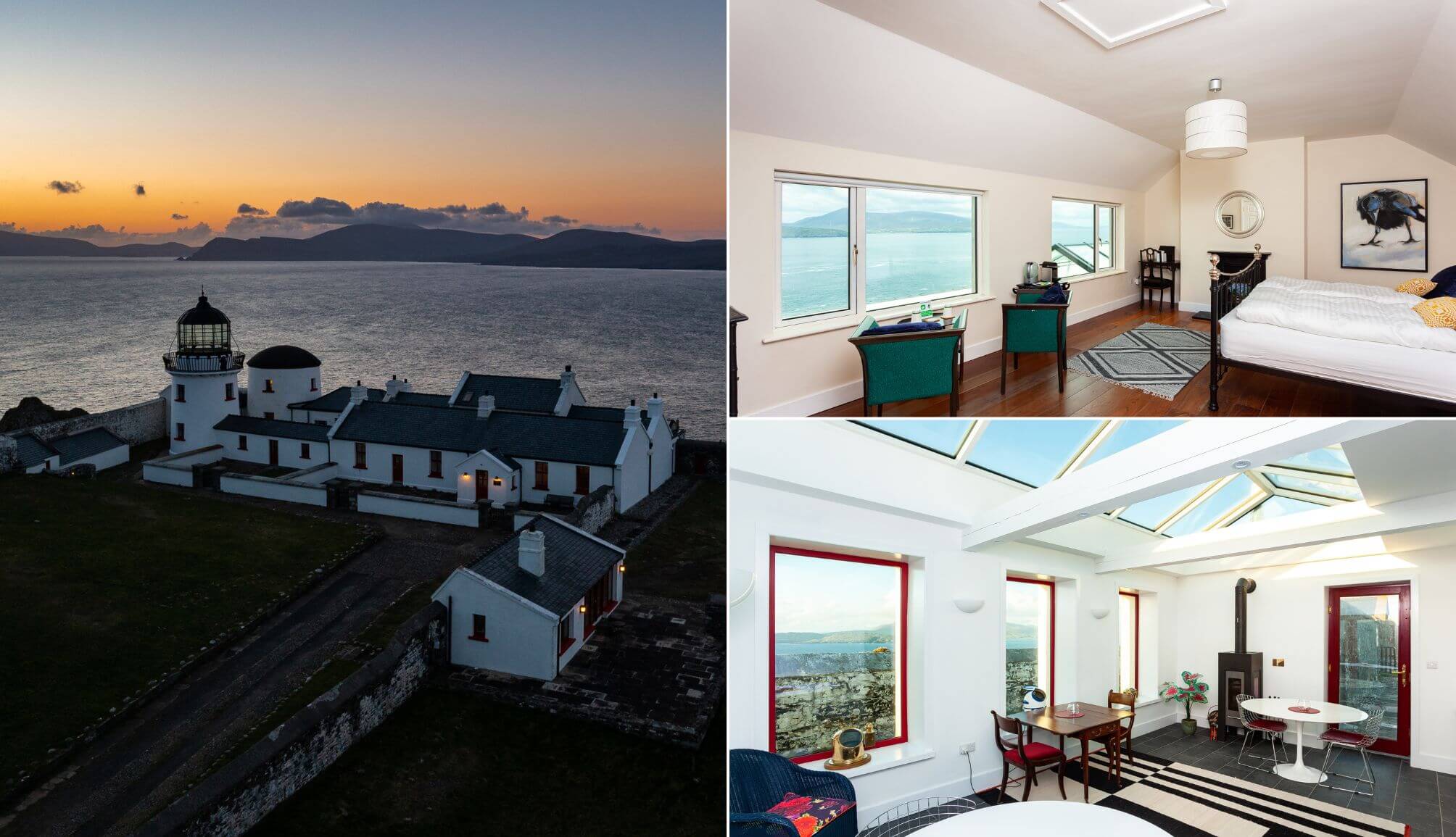
Seeing as the lighthouse offers such amazing views, why not stay there? The listed Clare Island Lighthouse has a clean, minimalist interior look and offers the weary traveller a sanctuary from the outside world. You can stay there from Wednesdays to Sundays.
The hostel
The Go Explore Hostel is located in the House of the O’Donnels, the landlords of the Clew Bay area in the mid-1800s and it sits on top of a small cliff. It has all the modern facilities you would expect of a hostel and there’s an in-house traditional bar.
B&Bs and guesthouses
There are plenty of B&Bs and guesthouses on Clare Island, including the Sea Breeze B&B, and O’Grady’s Guest Accommodation. Expect a warm welcome and a hearty breakfast.
Camping
Clare Island campsite is close to the pier and has showers, a drinking water tap and toilets available, and it costs €10 per tent. Enjoy a stay on the island that gets you as close to nature as possible.
Clare Island pubs and places to eat

There’s a handful of places to eat and pubs on Clare Island and, as you can see from the snap above, they look a little bit deadly!
1. Macalla Farm
This a small, family run yoga and meditation retreat centre and working organic farm. It offers seasonal vegetarian cooking courses and mindful eating retreats. Most of the dishes they make come from ingredients that are locally grown and they specialise in sour dough bread making, which you can learn to do yourself on one of the courses.
2. Clare Island Community Centre
You can also grab a bite to eat and a pint at Clare Island Community Centre. This is a community owned property and all of the profits that are made here go back into the Clare Island community.

Keith O’Hara has lived in Ireland for 35 years and has spent much of the last 13 creating what is now The Irish Road Trip guide. Over the years, the website has published thousands of meticulously researched Ireland travel guides, welcoming 40 million+ visitors along the way. In 2022, the Irish Road Trip team published the world’s largest collection of Irish Road Trip itineraries. Keith lives in Dublin with his dog Toby and finds writing in the 3rd person minus craic altogether.