
Driving in Ireland: An Irishman’s Guide for Tourists

Is driving in Ireland as a tourist difficult? It can be but it doesn’t have to be!
The main mistake many tourists make is that they do zero prep.
- The result? A lack of confidence and potentially dangerous situations
- The solution? Preparation both before your trip and when you arrive
The need-to-knows if you’re driving in Ireland for the first time
Many people spend heaps of time planning a trip to Ireland, and in particular getting their head around the mess that is renting a car in Ireland.
Below, you’ll find handy tips on how to drive in Ireland as an American, Australian or European. Enjoy!
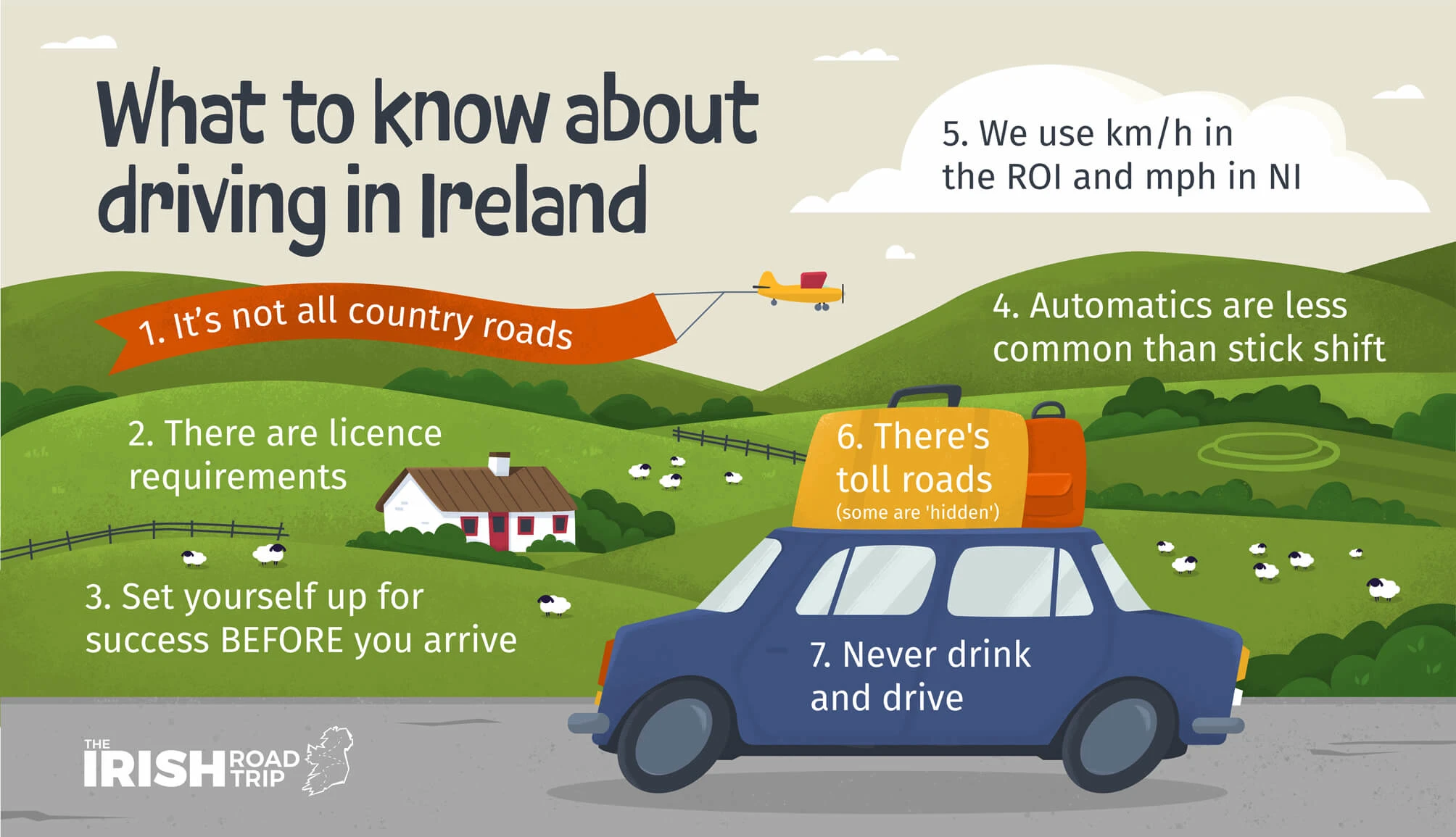
1. Make sure you meet the requirements
- For Americans: Those with a US license can drive for a visit of up to 12 months. Staying for over 12 months? You’ll need to apply for an International Permit
- For EU/EEA member states: Drivers from an EU/EEA member state (e.g. France, Germany, Belgium, etc.) are able to drive in Ireland for as long as their licence is valid
- Non-EU/EEA residents: The driving in Ireland requirements for no-EU/EEA/recognised states is straightforward – residents can drive with a valid national driving licence for up to 12 months
- Insurance requirements: You need to have insurance, either in your name or as a named driver, to legally drive in Ireland. If you’re renting a car in Ireland, a basic level of insurance is included in the rental cost by law.
2. Which side of the road
Cars in Ireland drive on the left hand side of the road.
3. It’s not all narrow country roads
Some documentaries of Americans driving in Ireland lead you to believe that it’s all one-lane-country-roads. These roads exist, but the condition of roads in many parts of Ireland is excellent.
4. Both km/h and mp/h are used
There are differences between Ireland and Northern Ireland when it comes to how speed is measured. In the 26 counties of the Republic of Ireland km/h is used while in the 6 counties of Northern Ireland mp/h is used.
5. Stick shift/automatic can be hard to get
Manual/stick shift, vehicles are more common in Ireland than automatics. Unfortunately, many people who plan on driving in Ireland for the first time fail to specify that they want an automatic when renting a car, and end up with a manual transmission instead.
6. Toll roads
There are 11 toll roads in the Republic of Ireland. 10 are the standard tool-both-style (i.e. pay with cash/card). However, 1, the M50 Toll, is a ‘free-flowing system’ that reads your number plate. You then pay in specific stores or online.
7. Drink driving
Never drink and drive. The drink-driving limit in Ireland is a BAC of 50mg (it’s 20mg for learner and novice drivers). For most people, 1 standard drink = a BAC of 20 – 50mg.
The most useful tip for driving in Ireland is to prep for these situations
One of the most overlooked tips for driving in Ireland for the first time is to check if you can legally drive here in the first place.
After that, it’s about anticipating the areas that are likely to cause you stress/a challenge. These driving in Ireland tips will set you up for success.
1. Driving on the left

I talk to a lot of Americans driving in Ireland and this tends to be the thing they most worry about. We drive on the left-hand side of the road in Ireland.
Now, for the most part, this should be fine. The problem is often remembering it, especially when you’re getting back into the car. Turning up your left sleeve or repeating ‘Left is best’ can hammer it into your brain.
2. Roundabouts, intersections and ‘right of way’

Roundabouts are generally one that cause people issues when driving in Ireland as a tourist, especially as there is often plenty of traffic around you.
Hit play on the video above to see what you need to do. Intersections/junctions can cause similar issues. The key thing to remember is right of way.
If you’re joining a road, the traffic in either direction on that road has the right of way and you must wait for it to clear. At a crossroad or roundabout, the traffic to your right has right of way, unless signage says otherwise.
3. Road signs

If you’re following one of our Ireland itinerary guides, you’ll encounter hundreds of road signs within minutes of driving in Ireland for the first time.
It’s imperative that you familiarise yourself with these in advance from Ireland’s Road Safety Authority.
4. Narrow roads
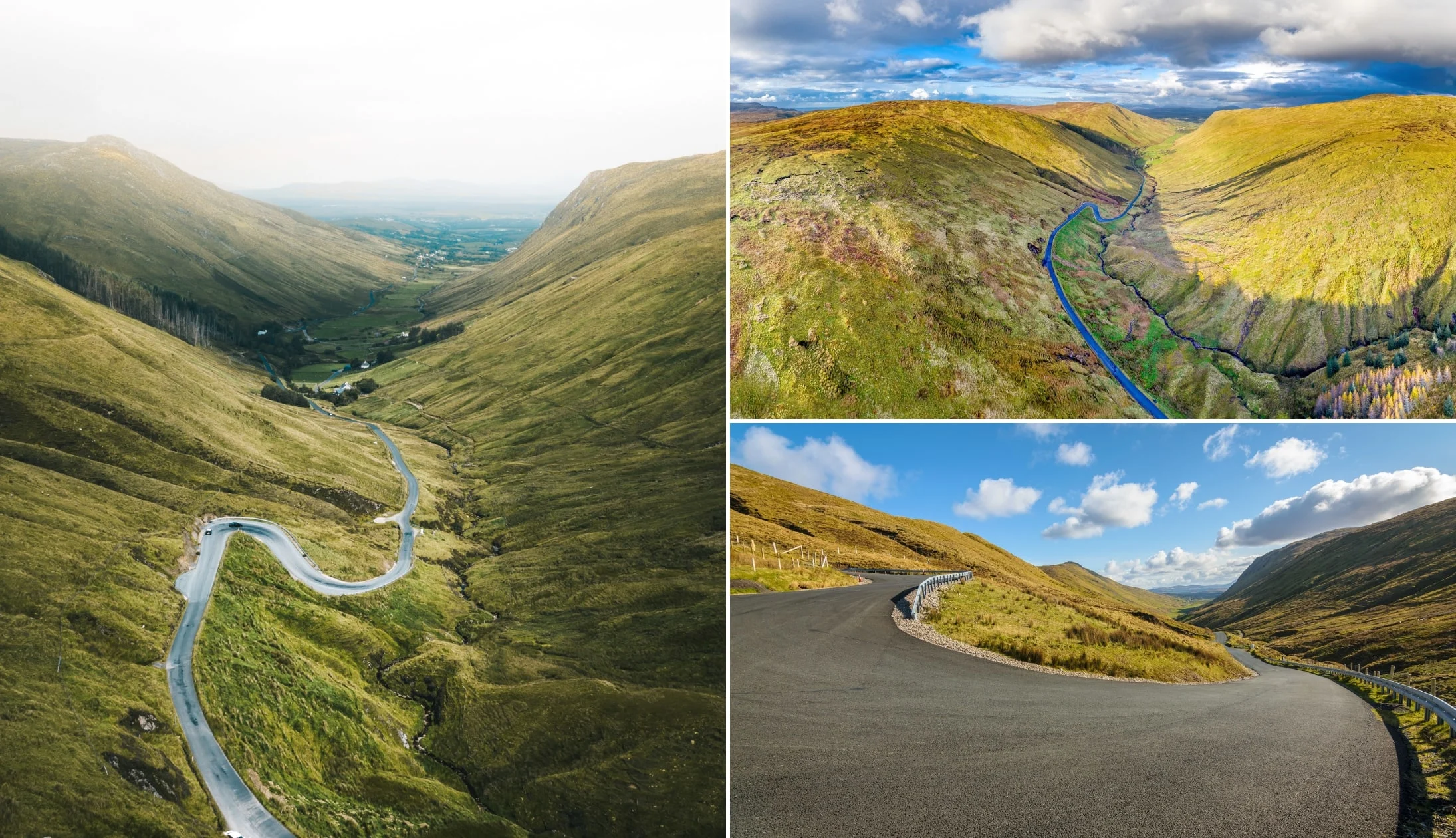
The next of our driving in Ireland tips revolves around those often-romanticised country roads. You meet them when you step off-the-beaten-path. If you’re used to narrow roads, you’ll have no problem.
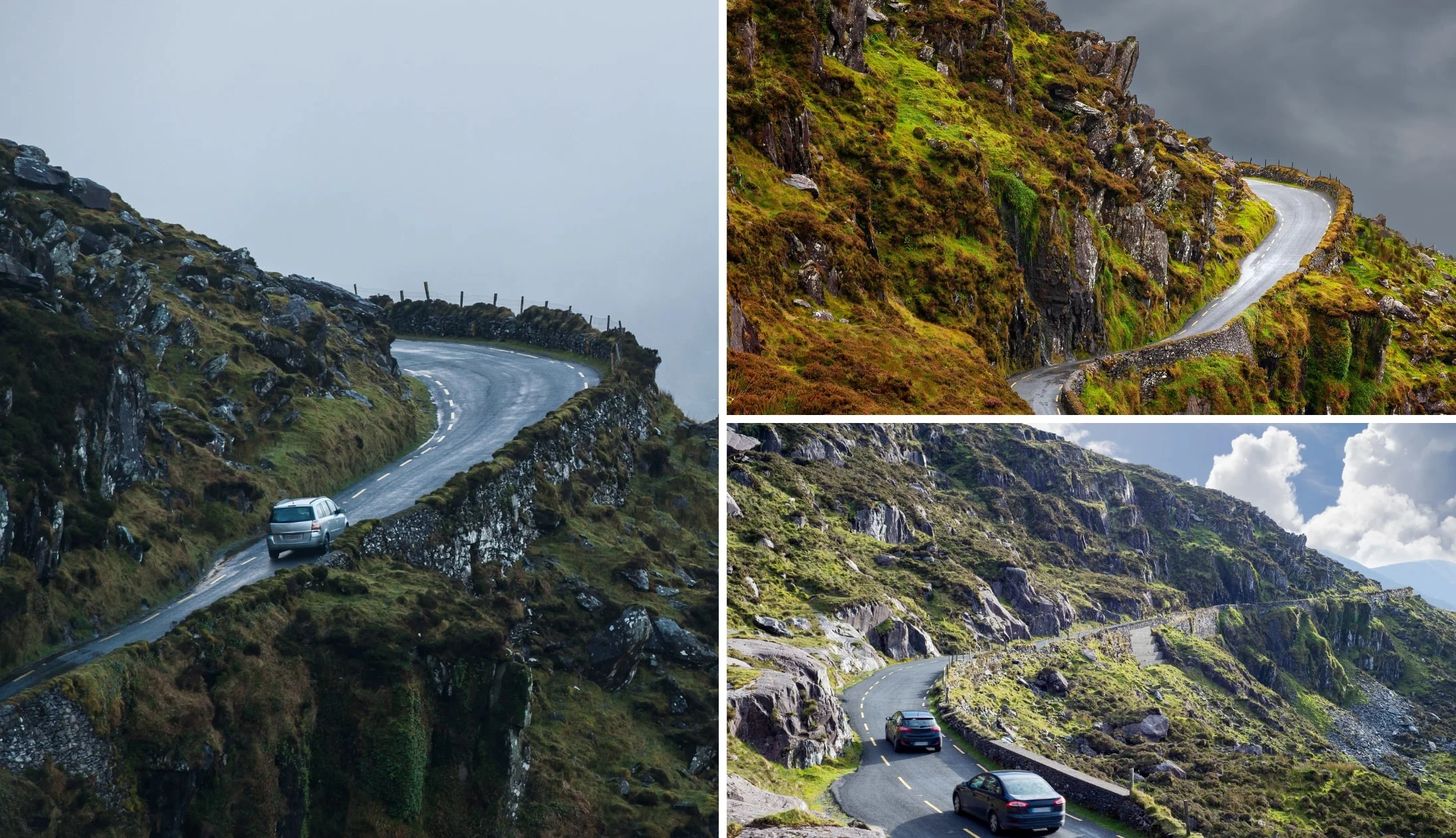
If you want to avoid these kind of roads (e.g. the ones on the Dingle Peninsula), plan your route out and use Google Satellite and Street View to gauge which roads may cause you issues and plan around them.
5. Using the cars key functions

Step four is for those renting a car and driving in Ireland for the first time. If you’re bringing your own car, you can skip this step.
When you pick-up your car rental in Ireland, sit inside and make sure you understand how to use each of the following:
- Mirrors (adjust prior to setting off)
- Indicators
- Headlights
- How to de-fog the windows
- Window wipers
- Hazard lights
- Fog lights
6. When you get your car, prepare on quieter roads

To set yourself up for success when driving, start with an easy route from you car rental spot.
For example, when leaving Dublin Airport, choose a route that helps you adjust to driving on the left.
- Option 1: The M1/M50 Motorways: The map above shows Dublin Airport and the busy M1/M50 Motorways, where speed limits reach 120 km/h. If you’re confident driving in Ireland, this is fine. If not, go with option 2.
- Option 2: A Quieter Route: I’ve mapped out a quieter route to help first-time visitors ease into driving. It avoids hectic roundabouts, follows simple roads, and ends in a large car park where you can regroup. This approach works for Shannon, Belfast, or any other arrival point – just map out a similar route.
7. Or be very prepared with these handy online lessons

If you like to be well-prepared, especially if you’re feeling a bit nervous about driving in Ireland for the first time, these online video lessons from Tripiamo are worth a look.
Reviewed and certified by Ireland’s largest driving school, the tutorials put you in the front seat and give you a clear, real-world sense of what it’s like to drive here.
They walk you through the rules of the road, let you virtually practise driving on the left, and cover everything you need to drive confidently in Ireland.
Key rules of the road when learning how to drive in Ireland
There are key rules of the road that you need to be familiar with when learning how to drive in Ireland.
Note: This is not an exhaustive guide on how to drive in Ireland – care, the ability to drive properly and preparation are all required.
1. Speed limits
Generally, there are 5 different types of speed limits in both the Republic of Ireland and Northern Ireland and they vary from 50 km/h (30 mph) in built-up areas to 100km/h on some motorways.
You’ll see the speed limits listed clearly on road signs while your drive around Ireland, so pay attention.
2. Changing lanes
If you need to change lanes, care must be taken. Keep an eye on the road signs so that you have plenty of time to move over and remember “mirror, signal, mirror, manoeuvre”.
First, check your mirrors to ensure your way is clear. Next, indicate your intent. Check your mirrors once more to ensure your lane is still clear, and if so, begin to move into the next lane.
3. Overtaking
When driving on a dual carriageway or motorway, you’re required by law to remain in the left-hand lane unless you’re safely overtaking another vehicle.
Check twice and indicate, before moving over. Once you’ve overtaken, repeat the process to return to the left-hand lane.
Stick to the speed limit as you overtake and look out for signs/markings indicating that overtaking is forbidden.
4. U-turns
U-turns are typically prohibited unless traffic conditions make the manoeuvre completely safe. On some roads, U-turns will still be prohibited even if conditions are safe.
Other roads that prohibit U-turns tend to be marked by either an upright sign or a continuous white line in the centre of the road.
5. Slowing down or stopping on a road
Occasionally you may find you need to pull over or slow down. Only do so if it’s safe and you can be sure you won’t block the road.
Before you begin to slow down, check your mirrors and then signal your intent by using your indicators or hazard lights and begin to slow down.
6. Driving at night
If you’re nervous and driving in Ireland for the first time, we’d recommend that you avoid driving in the dark until you’re confident.
When driving at night, ensure your windscreen and lights are clean (the weather in Ireland can play havoc on a cars condition!).
Headlights must be on when driving at night. Avoid high beams when driving in built-up areas, when there’s oncoming traffic, or if you’re driving behind someone.
7. Seat belts must be worn
By law, anyone driving along with all passengers must wear seat belts whenever the vehicle is in motion.
In Ireland, it’s the driver’s responsibility to ensure that all passengers are wearing their seat belts.
The only exception is for children under 150 cm (around 5 ft) tall and less than 36 kg (around 80 pounds) – they must use a suitable child restraint system.
8. Never use a phone
Regardless of whether your driving the Ring of Kerry or spinning along the Antrim Coast, NEVER use a hand-held phone while driving. This applies when you’re in stationary traffic too.
9. In case of an emergency
The Gardaí have a good breakdown on what to do for a variety of emergency types.
It’s also worth checking with your rental company to see what to do in the event of a minor incident (e.g. if the car won’t start).
Tips for driving in Ireland as an American

We get emails asking about how to drive in Ireland as an American every couple of days without fail.
As it stands, United States citizens can drive here for up to 12 months as a tourist. If you want to get an international permit, you can do so via the AAA in the US.
If you’re an American driving in Ireland for the first time and you’re worried:
- Relax: Follow the tips above and you’ll be well on the way to driving here with confidence
- Prepare: Take the online video lessons from Tripiamo so you can be even more prepared
- Follow: If you’re looking to follow a logical, straight-forward road trip itinerary but don’t want to do the research/planning, see our free self guided driving tours of Ireland.
FAQs

Since we started publishing Irish Road Trip itineraries many years ago, one of the most common queries we get is from those looking for tips for driving in Ireland.
Below, we’ve attempted to answer the most FAQs, but if you have one you’d like to ask, shout in the comment section.
Is driving in Ireland easy?
What side of the road does Ireland drive on?
Is Ireland driving the same as the UK?
Is it hard to drive in Ireland as an American?
Keith O’Hara has lived in Ireland for 35 years and has spent much of the last 13 creating what is now The Irish Road Trip guide. Over the years, the website has published thousands of meticulously researched Ireland travel guides, welcoming 40 million+ visitors along the way. In 2022, the Irish Road Trip team published the world’s largest collection of Irish Road Trip itineraries. Keith lives in Dublin with his dog Toby and finds writing in the 3rd person minus craic altogether.


Heya,
I was wondering if you would recommend leaving out any of your routes for first time Ireland drivers, just to be safe?
Love the site!
Best,
Christina
Hey!
The only road that I’ve ever encountered in Ireland that I think could potentially cause those driving for the first time a bit of hassle is Conor Pass in Kerry.
Aside from that, there are no roads that should cause you trouble once you take your time and drive carefully.
Is there anything in particular that you’re afraid of?
What are the pros and cons of driving clock-wise or counter-clockwise on a tour around the coast of Ireland, or on any of the local tour routes.?
It’ll depend entirely on the route.
There’s some places where you’ll get a better view depending on which way you approach it, e.g. approaching Healy Pass from the Kerry side will treat you to a much better view than if you drive up the hill from the Cork side
Hello, my name is Alex, I am from Republic of Moldova. Iam going to visit Ireland on my car. Tell me, please, how long can my car stay in Ireland? Thanks.
This is very informative! Thank you so much for this guide.
Only Irish learner permits are valid for use in Ireland. Other countries learner permits are not valid.
I’m planning a trip for 2023 in the Fall. This will be my second trip there, but the first time I hope to drive. I might alter that decision. My question is are all cars in Ireland manual shift? I know how to drive one with my right hand. Just curious.
Hey Sean – you can definitely request an automatic. Just make sure to select that option when booking!
Hi Keith. This is very helpful, thank you.
I would like to get your input on the following: A group of 6 (adults ages 25-55) will be traveling throughout Ireland (Dublin to Belfast to Galway to ??? then back to Dublin) for a week in August. We are debating if we should rent two smaller vehicles or one SUV. Some have suggested 2 vehicles since it will be our first time driving in Ireland (left side) and the roads are so narrow while others suggest one large vehicle (SUV) is not a concern….
What are your thoughts (1 large or 2 smaller vehicles)?
Thanks
Beth
Hey Beth! Personally, I’d look to rent two cars as squeezing 6 people into one with luggage and all the rest could get a bit tight.
I think it’s definitely worth looking at how you’re mapping out that itinerary, also. Dublin, Belfast and Galway is a good bit to squeeze into one week.
If it was me, I’d spend limited time in Dublin and then head to Belfast. Use the city as a base and drive the Causeway Coastal Route (endless natural beauty here).
Then head towards Galway and base yourself there. From the city, you can do day trips to Connemara (Galway) but you can also nip down to Clare, too, and up to Mayo.
I hope this helps!
@Keith O’Hara,
Thank you for your quick feedback and yes it helps. We plan to take your suggestions and head to Belfast (only spending time in Dublin the last day before flying out )
Luggage aside, from a safety aspect (can you tell that I’m the “mom” 🙂 in your opinion, is driving a smaller vehicle on the roadways (vs SUV) easier, thus safer, for tourists unfamiliar with Ireland’s roads ? (i.e. driving a large vehicle on driving on narrow roads )
I’ll be honest, I’ve seen as many near misses with small rental cars as I have with big ones, so I can’t really confidentially answer that. If it was me, the question I’d be asking myself is what will I be most comfortable driving (which would likely be a car/jeep as similar to my own as physically possible). Before renting the car, it’s worth becoming as familiar as possible with the rules of the road here. I live next to Dublin Airport and I use the motorway exit there around 4 times a week. I can’t begin to tell you the number of accidents/near misses I’ve seen there.
Great feedback
Dear Keith,
Do you have any tips for someone who just wants to stay on “good roads” as part of the wild atlantic way. I have a i8 which is unneccessarily wide but is a magnificent GT car and would love to give it a run in Ireland. I realise your comments of wavering and meandering off the main roads gives a fuller experience but would appreciate your ideas on what to do if your car isn’t quite made for the 3 foot roads.
Many thanks for your advice in advance.
Hey Niall – Love those i8s! My advice would be to play it by ear, but try and keep to the ‘main’ roads. People tend to think that Ireland has heaps of very narrow roads, but the majority of the ‘main’ roads in and around towns and villages will be perfectly fine for you. You’ll always (hopefully…) know when you’re coming to a narrow road and you can make a judgement before heading down it.
I’d definitely recommend having a look at your route in advance to see where you might be going off the beaten path. For example, if you were to go up Priest’s Lep or Brow Head in Cork you’d be in trouble!
Hi Keith,
Great site you’ve built here! Appreciate your attention to safety in this driving section. The cognitive overload at first for those of us who are used to driving on the right is enormous. We’re sitting on an unfamiliar side of the car, using non-dominant hands, possibly sleep-deprived from an overnight flight, having to navigate to an unfamiliar place via unfamiliar roads with unfamiliar markings…all in addition to the fact that our reflexes have been trained to respond to a very different traffic environment. For me, this manifested in a persistent glitch of misjudging which line of traffic was going which way when I was trying to turn from one road to another. Seems very simple, but I came close to causing a catastrophe a couple of times that first day despite my best efforts to be careful.
Cheers from this American for your no-nonsense focus on safety here!
Thanks,
Nick
This is a wonderful article. My husband & I have a system for staying safe. I always watch for him to stay on the left side when we first start out (it is easier to forget when you’ve just pulled out from a quick stop because of motor memory). I also do all of the navigation while he drives. That way his eyes stay on the road and I can let him know how soon we turn, if it’s a roundabout, etc. We have really enjoyed driving in Ireland, even on the small roads. I definitely recommend a small car though.
Great information Keith. I was wondering if you could suggest a car rental company to use or avoid. I am in Dublin for 4 days l will use city transit for those days. I will then rent a car for nine days. I am interested in renting away from the airport. Get in some practice in less congested traffic first. Thanks again Phillip
Hey Philip! Ah, I’d love to make a recommendation based on positive personal experience, but I can’t. To be completely honest, the only thing I do these days when it comes to car rentals (abroad, as I have a car here) is go off overall price, as reviews online are so hard to go off. I know this is of no use to you, so apologies! I hope the trip is mighty!
Hey, Keith. I have something I cannot find any information on is whether it’s legal to turn at a red light. In the US, where I am, it is legal to turn right on red in some states but not others. Is the equivalent, turning left on red, legal in Ireland? Is it any different in Northern Ireland? Thanks.
Hey Brendan – In Ireland you need to wait for a green light to turn and it’s the same in NI. Have a lovely trip!
Great advice, I rent about 60 cars a year on business here in the US. I never move my car until I understand how to operate the Wipers, Defroster, Lights, Shifter and Mirrors.
I like the idea of finding a place to practice driving on the left side of the road prior to departing the agency.
Well done!
Hi Keith, thanks for the great information! I’ll be taking a road trip this November. I’m worried about right of way on smaller roads that aren’t one-way. Do you just pull over to let the other driver pass? I’m not sure if I will encounter a lot of roads like this, but I have seen pictures of the roads. The road looks too small to fit more than one car. Thanks, Lisa
We learned a lesson the hard way when we rented a car in Ireland. Make sure you check what type of gas goes into the car. The Hertz rental people didn’t tell us and there was no sticker by the gas tank to indicate what type of gas the car used. My husband put in regular gas and turned out, the car used diesel. Needless to say, the car started running horribly and we had to have someone called by Hertz come out to drain the gas lines…when we returned the car at Shannon airport, the dummy light was still lit up on the dashboard and we had to pay an extra 800 euro because of this. I tried fighting the charge with Hertz to no avail.
I really apreciate your excelent work , I will travel to Ireland next summer and all the information you provided is a great help for me . Thank you so much, will be reading it for a while, I,m sure i,ll found many important and interesting piece of advice .
Great job Keith
Sagry from Madrid in Spain
Hey Keith! I wanted to thank you for creating such an in depth guide through this website. I wanted to ask you about parking. My friend and I are flying into Cork this month and doing a little Cork – Galway – Dublin excursion; we are thinking about renting a car. Anyway from my research I can’t seem to find any info on parking in the Republic of Ireland. I assume a lot of it has to be payed for and I was curious about what the average cost would be for parking during travels. Thank you so much for your time!
Hey Bella! It varies massively price wise. For example, you could end up paying 3.50 per hour in parts of Dublin city and then 1 euro per hour in other places. Then you’ll find other spots where it’s free. I hope this is of some help!
Just returned, rented a car and found this site extremely helpful.
Wanted to note:
Was pleasantly surprised to see the rental car had a touch screen with Android Auto (not sure about CarPlay). I brought my car chargers and a wireless Android Auto dongle not knowing what we would have. Both were helpful!
I found that Google Maps was better than using Waze, but Waze did have coverage. Found that destinations were easier to find in Google Maps than Waze.
Speed limits are the limit, not the suggested speed. Laughed several times on the one lane roads where the speed limit was 80km/h.
Tolls are well marked and easy to pay. M50 was the only one with a transponder I think. Others you could pay by coins, card or person, or I think you can drive through and pay online. We always opted to stop and pay, sounded like the fines were significant if you missed the 8pm payment deadline on the online payment system.
Hi – could you recommend departure from a train station (name/location) to head into Scotland to continue our journey? We plan to fly into Dublin, rent a car and tour for about 4 days. Where do we need to end up? thank you