
The Drive From Dublin to Killarney (Best Stops + Map)

The drive from Dublin to Killarney is one that many visitors do within their first few days of arriving to Ireland. It takes around 4 hours without stops, and there are two very different ways of approaching the drive.
The two fastest routes are almost identical in distance, while the third is for those after a more scenic route:
- Option 1 (via Limerick): Follow the N7/M7 towards Limerick before continuing through Adare and on to Killarney (318km)
- Option 2 (via the M8): Follow the N7/M7 before joining the M8 towards Cork and continuing to Killarney (317km)
- Option 3 (the scenic route): Roughly follows Option 2, but covers 344km and takes in some very historic attractions
The main stops on the drive from Dublin to Killarney

Take a moment to look over my map above as it’ll give you a sense of where the Dublin to Killarney road trip will take you.
This route takes in a mix of well-known attractions, like the Rock of Cashel and Cahir Castle, along with lesser-known spots, like Aghaboe Abbey. Here are some of the most frequently asked questions about the journey.
How long does it take to drive from Dublin to Killarney?
The drive from Dublin to Killarney takes around 4 hours without stops. This will vary depending on traffic, particularly if you’re leaving Dublin during rush hour, as the M50 traffic begins to build up from around 15:00.
How far is Dublin from Killarney?
The distance from Dublin to Killarney is approximately 317km (197 miles) via the M8 or 318km (198 miles) via Limerick and Adare.
How long does the scenic route take?
I’d allow a full day for the scenic route outlined on my map above, particularly if you plan on visiting several of the stops. Now, you don’t have to visit every attraction on the map – if you’re short on time, I’d prioritise the Rock of Cashel and Cahir Castle, as both are well worth a visit.
The Dublin to Killarney road trip
The Dublin to Killarney road trip outlined below takes in 7 stops, from the Japanese Gardens in Kildare to the mighty Rock of Cashel in Tipperary.
You don’t need to visit them all. I’ve included a mix of well-known attractions and lesser-visited spots, so you can pick and choose based on your interests and how much time you have.
1. The National Stud and Japanese Gardens

The first optional stop is the Irish National Stud and Japanese Gardens in Co. Kildare, around an hour’s drive from Dublin. Now, if you’ve no interest in horses, don’t let that put you off.
The Japanese Gardens here are some of the finest in Europe, with winding paths, waterfalls, ponds and colourful planting. There’s also the Irish Racehorse Experience, where you can learn about the life of a thoroughbred, along with guided tours of the stud.
It’s a handy spot for a bite to eat, too, with the Japanese Gardens Restaurant serving meals, cakes and coffee.
2. The Rock of Dunamase

The second stop is the Rock of Dunamase, a 25-minute drive from the Irish National Stud. This ruined hilltop fortress dates back to the 9th century, when a fort was established here.
It was attacked by Vikings in 845, but most of the ruins you’ll see today date to the late 1100s, when the Normans built a castle on the site. In 1170, Diarmuid Mac Murrough, King of Leinster, handed Dunamase over to Strongbow in return for military support.
I was here recently and the one thing I’d say is that you should take great care on the approach, as these are narrow, rural roads with plenty of blindspots.
Now, a few things worth knowing before you visit:
- Parking: There’s no proper car park, but you’ll find space across from the church (here on Maps)
- The walk: It’s a short, 2-minute walk uphill to the ruins
- The views: You’ll get mighty views across the countryside towards the Slieve Bloom Mountains
- Warning: The ground is uneven with steep drops, so watch your footing
3. Aghaboe Abbey
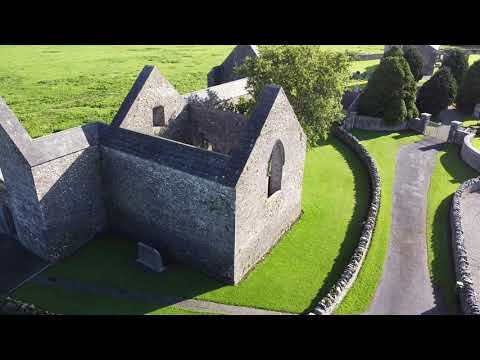
The third stop is Aghaboe Abbey, a 30-minute drive from the Rock of Dunamase. Now, this is probably the lesser-known of the stops on the drive from Dublin to Killarney, but it’s worth considering.
Founded by St. Canice in the 6th century, the abbey became an important centre of learning, trade and agriculture. One of its most famous abbots was St. Virgilius, an astronomer who left Ireland in the 8th century and went on to become Bishop of Salzburg in Austria.
The original monastery burned down in 1234, while the ruins you’ll see today are largely from a Dominican friary built in 1382.
There are a few things worth looking out for here:
- The ruins: Keep an eye out for the beautifully carved three-light window in the east wall
- The old church: The neighbouring Church of Ireland building dates to the 1700s and contains some medieval stonework
- The Norman motte: You’ll find the remains of an old Norman defensive mound nearby
4. The Rock of Cashel
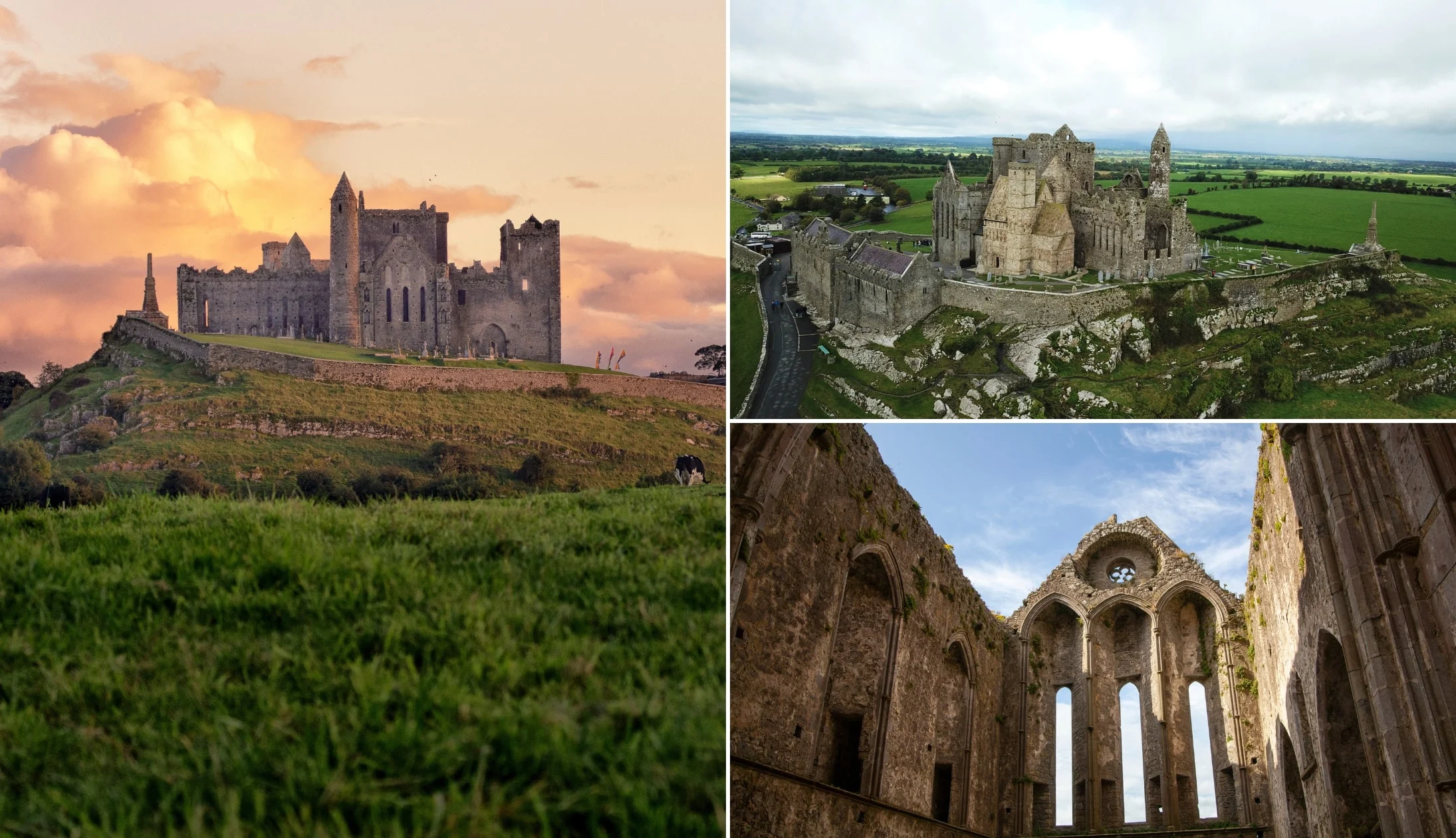
The fourth stop is the Rock of Cashel in County Tipperary, a 42-minute drive from Aghaboe Abbey. This is one of Ireland’s most impressive historical sites, and I’d highly recommend making time for it.
Perched on a limestone outcrop overlooking the Golden Vale, it was once the seat of the Kings of Munster. Brian Boru was crowned High King here in 978, and in 1101, the site was handed over to the Church.
Today, you’ll find a collection of medieval buildings, including a round tower, Gothic cathedral and Cormac’s Chapel, which contains Ireland’s only surviving Romanesque frescoes.
A few things worth knowing:
- Admission: €8 for adults, €6 for seniors and €4 for children/students
- Parking: There’s a public car park close to the entrance
- Cormac’s Chapel: You can only enter on a guided tour. Tickets are limited and must be bought on-site
- Weather: The Rock is very exposed and can close during bad weather
- Lunch: Cashel is also a great spot to stop for lunch. I tend to head to Ladyswell Restaurant in the town. They do good sambos, soup and heartier feeds if you fancy something more substantial
5. Cahir Castle

The fifth stop on the drive from Dublin to Killarney is Cahir Castle, a 20-minute drive from the Rock of Cashel. This is one of the largest and best-preserved medieval castles in Ireland, and it’s well worth a visit if you’ve an interest in history.
Built in the 13th century on a rocky island in the River Suir, it was a stronghold of the powerful Butler family. The castle was considered almost impossible to capture, but that changed in 1599 when the Earl of Essex attacked it with heavy artillery.
Much of the original structure remains, and you can explore the castle’s towers, courtyards and defensive walls. It has also appeared in films and TV shows, including Excalibur and The Tudors.
A few things worth knowing:
- Admission: €5 for adults, €4 for seniors and €3 for children/students
- Location: Right in the centre of Cahir Town
- Opening: Year-round, with seasonal hours
- Time needed: I’d allow 45 – 60 minutes for a visit
6. Doneraile Wildlife Park or Mallow Castle

The final stop on the Dublin to Killarney road trip gives you two options, both of which are handy for breaking up the journey.
You’ve just under 2 hours of driving between Cahir and Killarney, so I’d recommend stopping at one of these before tackling the final stretch.
Option 1: Doneraile Wildlife Park (40 minutes from Cahir)
If you fancy stretching your legs, Doneraile Wildlife Park in County Cork would be my pick. This large park is set around an 18th-century estate and has several walking trails that take you through woodland, past lakes and along the River Awbeg.
You’ll also have a chance to spot deer roaming around the estate. It’s free to enter, and you can easily spend 30-60 minutes here without tackling one of the longer walks.
Option 2: Mallow Castle (52 minutes from Cahir)
Alternatively, you could head to Mallow Castle, which sits beside the River Blackwater in Mallow Town. Here, you’ll find the ruins of a 16th-century fortified house alongside a later mansion, with gardens and parkland to explore.
It’s a good option if you fancy a shorter stop before continuing on to Killarney.
What to do when you arrive in Killarney

You’ve had a long day, so check-in to your accommodation (see my guide on where to stay in Killarney) and then head out into the town.
- Restaurants in Killarney: Cronins (classic Irish dishes), Porterhouse (great steaks, seafood and cocktails) and The Mad Monk (excellent fresh seafood and daily grill specials)
- Pubs in Killarney: O’Connors (old-school pub with excellent Guinness) and Jimmy Brien’s (small, traditional and usually full of locals)
- Live music: Murphy’s Bar (traditional sessions in a cosy setting) and J.M. Reidy’s (buzzy late-night spot with several bars inside)
- Itineraries: If you’re looking for things to do, see my Ring of Kerry guide or my itinerary for spending 2 days in Killarney or 3 days in Killarney
Keith O’Hara has lived in Ireland for 35 years and has spent much of the last 13 creating what is now The Irish Road Trip guide. Over the years, the website has published thousands of meticulously researched Ireland travel guides, welcoming 40 million+ visitors along the way. In 2022, the Irish Road Trip team published the world’s largest collection of Irish Road Trip itineraries. Keith lives in Dublin with his dog Toby and finds writing in the 3rd person minus craic altogether.


