
What to do in Dublin if You Have an Early Arrival

For the last 10 years, I’ve been helping people plan trips to Ireland, and one problem that comes up time and time again is early arrivals into Dublin Airport.
Many visitors, particularly those flying overnight from America, land in Dublin between 4-and-6am, exhausted and ready for a shower, only to discover that their hotel won’t let them check in until 2pm or 3pm.
As someone who’s lived in Dublin for 37 years, I’ll show you how I’d tackle an early arrival, from dealing with luggage and hotel check-in to finding breakfast and making the most of your first few hours in the city.
What to do if you arrive in Dublin early
The first thing to remember is that your flight’s landing time isn’t the time you’ll reach your hotel. Between clearing Dublin Airport, collecting your luggage and travelling into the city, I’d allow around 1.5-2 hours. This makes a big difference.
If you land at 4am, you could be at your hotel by 6am, with another 8-9 hours to wait before check-in. Land at 9am, however, and you might only have 3-4 hours to fill.
My recommendation: If you’re arriving very early after an overnight flight, and your budget allows, I’d book your hotel for the previous night. That way, you can head straight to your room, shower and get some sleep.
Yes, it’s an extra expense, but after a long flight, having a room ready when you arrive can make a huge difference to your first day in Ireland. If you’d rather save the money, there are a couple of other ways to approach your morning.
| Your situation | What I'd recommend |
|---|---|
| You want the easiest arrival | Book your hotel for the previous night. Head straight to your room when you land, shower and get some sleep. |
| You're exhausted but don't want to pay for an extra night | Drop your bags, grab a coffee and breakfast when somewhere opens. Take a gentle stroll, then relax in the hotel reception until check-in time. |
| You got a good sleep on the plane | Drop your bags, have breakfast and spend the morning exploring Dublin. Once your room is ready, head back for a shower and a short nap if needed. |
The argument for booking your hotel for the night before you land

If you’re landing at 5am or 6am after barely sleeping on your flight, booking your hotel for the previous night is one of the best travel tips for Ireland that I can give you.
For example, if you’re landing on Tuesday morning, book your room from Monday. You’ll be able to head straight to the hotel, have a shower and get some sleep rather than waiting around until the afternoon.
The obvious downside is the cost. Dublin hotels can be ridiculously expensive, particularly during the summer, and paying for a night you’re barely going to use won’t suit everyone’s budget. If you do go down this route, make sure you tell the hotel that you’ll be arriving the following morning so they don’t mark you as a no-show.
Personally, I wouldn’t bother with the extra night if I was arriving after a short flight from somewhere like London. If the extra night isn’t an option, contact your hotel before travelling and ask about early check-in. Don’t rely on getting into your room early, but at least you’ll know whether you can leave your bags and head off to enjoy the morning.
Getting from Dublin Airport to your accommodation

Dublin Airport is around 12km from the city centre and, unfortunately, there’s no train or tram connecting the two. Your main options to get from Dublin Airport to the city centre are to take a bus or taxi, and which I’d recommend depends on your budget, where you’re staying and how tired you are after your flight.
- Taxi/Uber: If I was arriving after an overnight flight from America, this would be my preference, particularly if travelling as a couple. Expect to pay roughly €25-€40 to reach the city centre, depending on traffic and your destination.
- Dublin Express and Aircoach: These are good alternatives to a taxi, particularly if your hotel is near one of their stops. Both operate dedicated airport coach services to various locations around Dublin.
- Dublin Bus: Routes 16 and 41 are cheaper options, but they make plenty of stops and can take considerably longer. You’ll need the correct cash fare or a valid Leap Card.
- Leap Card: If you’re planning to use public transport during your stay, it’s worth familiarising yourself with the Leap Visitor Card. The standard TFI 90 Minute Fare covers eligible journeys on Dublin Bus, Luas and other participating services. Alternatively, the Leap Visitor Card offers unlimited travel on participating services for a set period. Neither covers Dublin Express or Aircoach.
- Rental cars: Getting around Dublin car-free is very easy – you don’t need a car. See my guide to renting a car in Ireland if you need one for the rest of your Ireland itinerary
How to spend your first morning in Dublin

If you’ve dropped your bags and have a few hours to spare before check-in, I’d recommend getting some breakfast and heading off for a wander around Dublin. One of the things I love about Dublin is how compact the city centre is.
You can see many of its best-known landmarks on foot, and you don’t need to spend a fortune doing it. Here are a few of my favourite breakfast spots in Dublin City:
- Lemon Jelly Café (Millennium Walkway): One of my favourite spots for a full Irish breakfast. There’s plenty of seating, and it’s a handy starting point if you’re exploring the north side of the city.
- Beanhive Coffee (Dawson Street): A lovely little spot for coffee and a hearty breakfast, particularly if you’re planning to explore Trinity College or St. Stephen’s Green.
- Joy of Chá (Temple Bar): A long-standing café in the heart of Temple Bar that serves an all-day Irish breakfast. Handy if you’re starting your morning on the south side of the Liffey.
1. The short and easy Dublin walk

If you’ve just stepped off an overnight flight, you might not fancy trekking across Dublin to see the sights. Instead, I’d recommend spending a few hours exploring the area around your hotel.
For example, if you’re staying in Ballsbridge, you could take a stroll through Herbert Park or head towards Sandymount Strand for some fresh sea air. If you’re staying in the city centre, you could wander along Grafton Street, explore St. Stephen’s Green or take a walk along the River Liffey.
The idea here isn’t to cram in attractions. It’s to get some fresh air, stretch your legs after the flight and ease yourself into your first day in Dublin.
2. Discover Dublin’s historic centre
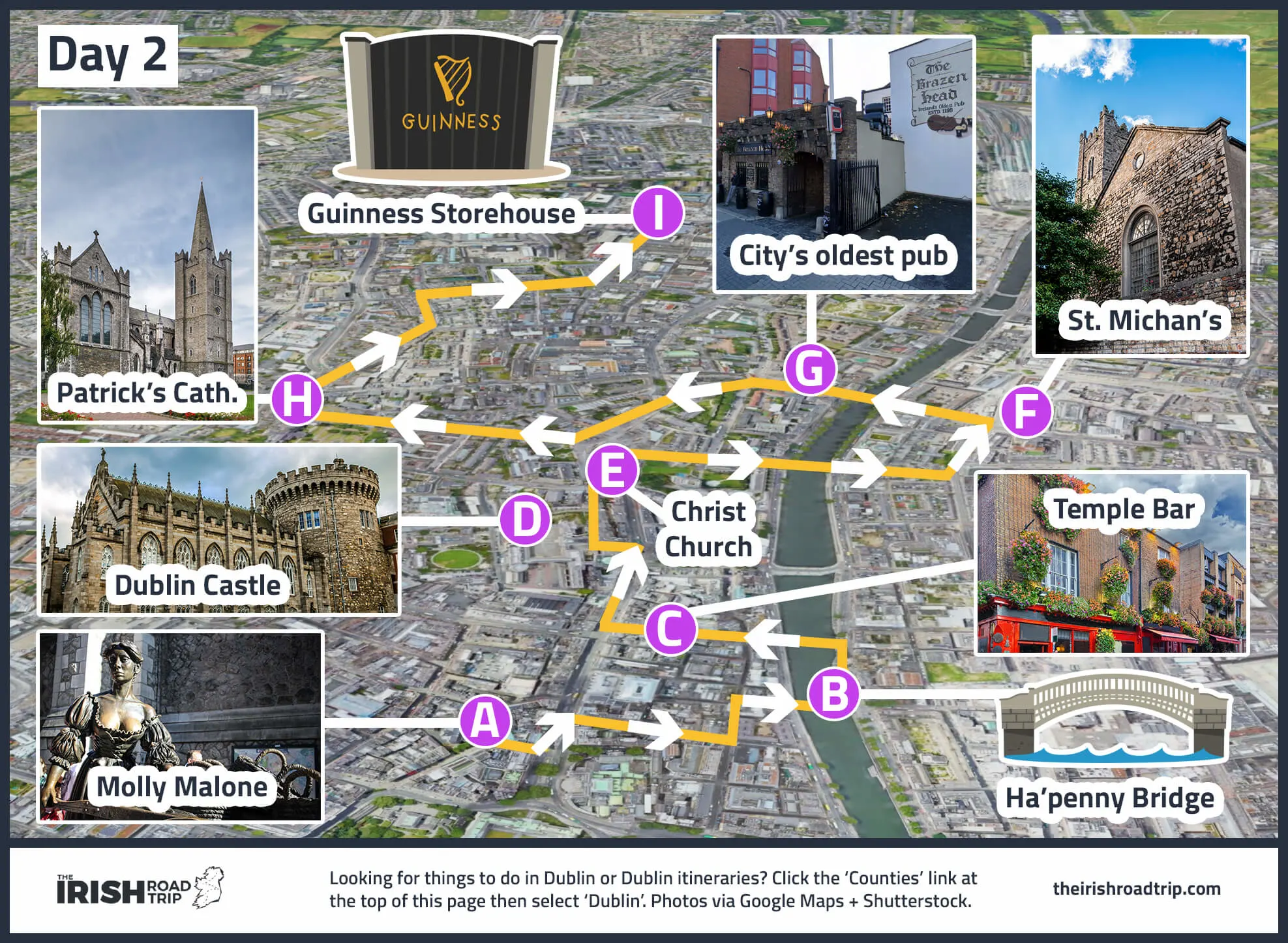
This route takes you past some of Dublin’s best-known landmarks, including the Ha’penny Bridge, Dublin Castle, Christ Church Cathedral and St. Patrick’s Cathedral.
I’ve included the full walking route in the map above, but I wouldn’t recommend tackling the whole thing after an overnight flight. Instead, pick two or three stops that are close to where you’re staying.
If you’re out very early, most attractions won’t be open, but you can still admire the buildings and enjoy the streets before they get busy.
3. Explore Dublin’s Georgian Quarter

This route takes you through some of Dublin’s most attractive streets and green spaces, passing Iveagh Gardens, St. Stephen’s Green, Merrion Square and Trinity College.
I’ve included the full route in the map above, but there’s no need to tackle the whole thing after an overnight flight. I’d recommend picking a few stops close to your accommodation.
If you’re out early, the museums and other indoor attractions may not be open yet, but you can still admire the Georgian architecture and enjoy a stroll through the city. For the rest of your time in Dublin, follow one of these itineraries:
- How to spend 24 hours in Dublin
- The perfect 2 day Dublin itinerary
- A varied 3 days in Dublin
- An adventure-packed 4 days in Dublin
4. Other ways to spend your first morning in Dublin

If you’re not keen on spending your first morning walking around the city, there are a few alternatives worth considering. Personally, I’d lean towards something that doesn’t involve too much planning or rushing around, particularly after an overnight flight.
- Hop-on hop-off bus: This is a good option if you’re tired but still want to see some of Dublin. I did something similar in Galway last year with a friend who’d flown into Shannon, and it was a great way to see the city without having to walk everywhere. You can sit back, listen to the commentary and get your bearings without using up too much energy.
- A guided walking tour: If you’re feeling reasonably fresh, a guided tour is a great way to get your bearings and learn a bit about Dublin’s history. Personally, I think it’s hard to beat the Historical Walking Tour
- An indoor attraction: If the weather is miserable, I’d consider EPIC The Irish Emigration Museum or the National Gallery of Ireland. Both are worth visiting, although I’d lean towards the gallery if you want something you can explore at your own pace.
What to do when your hotel room is ready

By the time your hotel room is ready, usually around 2pm or 3pm, there’s a good chance the tiredness will have caught up with you. I’d head back, have a shower and, if you’re struggling to keep your eyes open, get some rest.
You’ll often hear people say that you should force yourself to stay awake until bedtime to beat jet lag. That’s all well and good in theory, but after an overnight flight and several hours exploring Dublin, it’s easier said than done.
Personally, I wouldn’t feel guilty about having a short nap. Set an alarm for 30-60 minutes and try to avoid sleeping for several hours, as you’ll want to start adjusting to Irish time. For your first evening, I’d keep things simple.
Head out for a nice meal (see my guide to Dublin’s best restaurants) – my favourites are Hawksmoor for steak, SOLE for seafood or Pickle for Indian. If you’ve a bit of energy left afterwards, some of the best pubs in Dublin are:
- For Guinness: Bowes or Mulligan’s
- Live music: The Cobblestone or Darkey Kelly’s
- A unique setting: The Bank, the Palace or Neary’s
FAQs

What can you do in Dublin at 6am?
If your flight lands at 6am, you’ll likely spend the next hour or more clearing the airport, collecting your luggage and travelling into Dublin. Once you’ve dropped your bags at your accommodation, I’d recommend finding somewhere for breakfast before exploring. Most attractions won’t be open that early, but you can still wander around areas like Temple Bar and along the River Liffey.
Can you check into a Dublin hotel early?
Yes, some Dublin hotels offer early check-in, but it depends on room availability. Standard check-in is usually around 2pm or 3pm. I’d recommend contacting your hotel before travelling to ask, but don’t rely on getting into your room early. If you’re arriving at 5am or 6am after an overnight flight, consider booking the previous night.
Can you leave luggage at a Dublin hotel before check-in?
Yes, most Dublin hotels will store your luggage before check-in, free of charge. If you’re staying in an Airbnb or accommodation without luggage storage, there are independent luggage storage services around Dublin City Centre.
Should you sleep when you arrive in Ireland?
I’d recommend trying to adjust to Irish time as quickly as possible, but that doesn’t mean forcing yourself to stay awake when you’re exhausted. If you’ve had very little sleep on an overnight flight, a short 30 minute afternoon nap will help. I’d avoid sleeping for several hours during the day, as it could make adjusting to the time difference more difficult.
How long does it take to get from Dublin Airport to the city centre?
Allow roughly 30-60 minutes for the journey from Dublin Airport to the city centre, depending on your transport and traffic. You’ll also need to factor in the time spent getting through the airport and collecting your luggage. If your flight lands at 6am, arriving at your city-centre hotel around 7:30am or later is a reasonable estimate, although it can take longer.
Keith O’Hara has lived in Ireland for 35 years and has spent much of the last 13 creating what is now The Irish Road Trip guide. Over the years, the website has published thousands of meticulously researched Ireland travel guides, welcoming 40 million+ visitors along the way. In 2022, the Irish Road Trip team published the world’s largest collection of Irish Road Trip itineraries. Keith lives in Dublin with his dog Toby and finds writing in the 3rd person minus craic altogether.


